Winter feeders / Model guide
Suet Feeders for Woodpeckers
The extended panel below the cage is not decoration. Woodpeckers brace on their tail feathers, and a feeder that gives them nothing to brace on is one they visit briefly and leave.
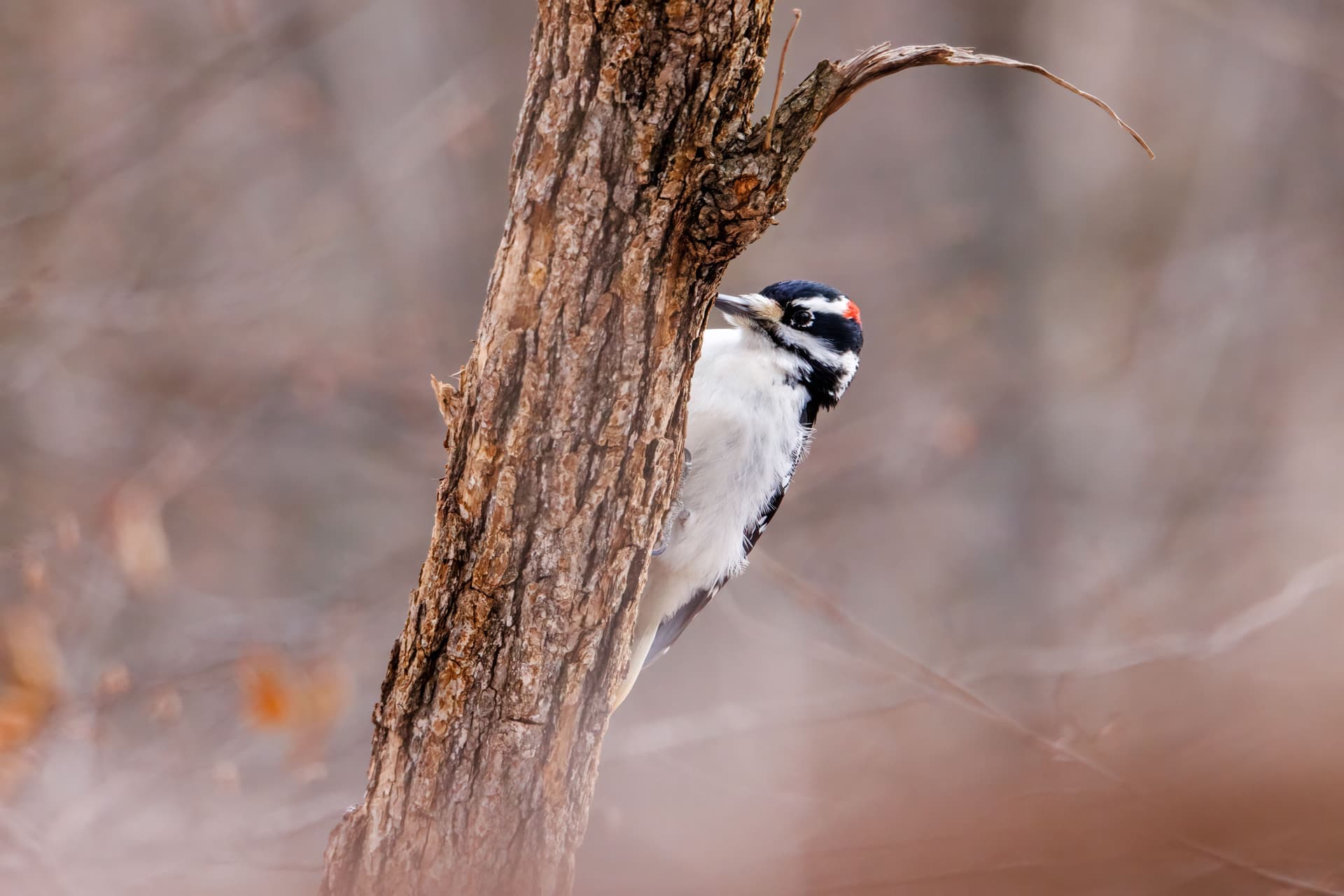
Buy a cage with a tail prop — an extended flat panel below the cake. Woodpeckers feed on vertical trunks by bracing their stiff tail feathers against the bark, and a feeder that gives them nothing to brace on forces an awkward posture they will not hold for long. The Nature's Way CWF1 is the straightforward version.
Winter Perch is funded by affiliate commission. If you buy through a link on this page we may earn a commission at no extra cost to you, and it never decides a ranking. Full disclosure · how we pick.
Quick picks
Ranked, with the trade-off named. Tap a row for the full write-up; the price button goes straight to Amazon.
| # | Product | Best for | Price |
|---|---|---|---|
| 1 |  Nature's Way CWF1 Cedar Tail-Prop Suet FeederThe extended cedar tail is not decoration: woodpeckers brace on their tail feathers, and a feeder without a prop makes them work at an angle they do not like. | Woodpeckers, because of the tail prop | Check price on Amazon |
| 2 |  Nature's Way CWF2 Cedar Upside-Down Suet FeederThe cake faces down, so a bird has to hang underneath to eat. Woodpeckers, nuthatches and chickadees do that happily. Starlings largely will not. | Starling exclusion without a mechanism | Check price on Amazon |
| 3 |  C&S Woodpecker Delight No-Melt Suet DoughA coarser, nuttier blend aimed at the birds that cling and hammer rather than perch and peck. | Downies, hairies and red-bellied woodpeckers specifically | $7.14 · See it on Amazon |
| 4 |  Birds Choice Upside-Down Suet Feeder, multi-cakeRecycled poly lumber, a roof, and room for more than one cake — the upside-down feeder for a yard where one cake lasts three days. | Multi-cake capacity in recycled poly that will outlive the cedar | $54.99 · See it on Amazon |
#ad how we are funded · price as of October 15, 2026
The picks in full
Top pick Woodpeckers, because of the tail prop
Nature's Way CWF1 Cedar Tail-Prop Suet Feeder
The extended cedar tail is not decoration: woodpeckers brace on their tail feathers, and a feeder without a prop makes them work at an angle they do not like.
Specifications
- Capacity
- 1 standard cake
- Dimensions
- 12"H x 7.875"L x 3"W
- Material
- Cedar
- Feature
- Extended tail prop
Trade-offs
- The tail prop measurably changes which species will settle and feed
- Cedar weathers gray instead of rotting
- A simple cage front — no mechanism to jam with ice
- Fits every standard cake on this site
- One cake only
- The open cage means starlings feed as easily as woodpeckers
- No roof, so the cake takes weather directly
Who it is forA first suet feeder in a yard with downy or hairy woodpeckers around.
Skip it ifSkip it if starlings dominate your yard. An open tail-prop cage is the easiest feeder in this category for a flock to strip.
#ad how we are funded · price as of October 15, 2026
Where these specs came from
No. 2 Starling exclusion without a mechanism
Nature's Way CWF2 Cedar Upside-Down Suet Feeder
The cake faces down, so a bird has to hang underneath to eat. Woodpeckers, nuthatches and chickadees do that happily. Starlings largely will not.
Specifications
- Capacity
- 1 standard cake
- Orientation
- Downward-facing cake
- Material
- Cedar with roof
- Mechanism
- None — geometry only
Trade-offs
- Excludes most starlings through geometry, with nothing to break or freeze
- The roof keeps snow and rain off the cake
- Cedar body, weathers well
- Clinging birds are the ones you wanted anyway
- It is not perfect — determined starlings learn to hang
- Loading a cake face-down is fiddlier than a front-opening cage
- One cake
Who it is forAnyone whose plain cage feeder has been taken over by starlings or grackles.
Skip it ifSkip it if your main visitors are cardinals and jays, which will not hang upside down. You will have excluded the birds you were feeding.
#ad how we are funded · price as of October 15, 2026
Where these specs came from
No. 3 Downies, hairies and red-bellied woodpeckers specifically
C&S Woodpecker Delight No-Melt Suet Dough
A coarser, nuttier blend aimed at the birds that cling and hammer rather than perch and peck.
Specifications
- Format
- Standard cake
- Type
- No-melt dough
- Targets
- Woodpeckers
Trade-offs
- Formulated around the species most people put a suet feeder up for
- No-melt dough, so it survives a thaw on a tail-prop feeder
- Pairs directly with a tail-prop or upside-down cage
- Narrower appeal than a general high-energy cake
- The coarse texture is less useful to the smallest birds
Who it is forYards with woodpeckers already visiting, where the point is to keep them.
Skip it ifSkip it if you are still trying to attract your first woodpecker. Get them in on a general high-energy cake first; a specialist blend does not create traffic that is not already there.
#ad how we are funded · price as of October 15, 2026
Where these specs came from
No. 4 Multi-cake capacity in recycled poly that will outlive the cedar
Birds Choice Upside-Down Suet Feeder, multi-cake
Recycled poly lumber, a roof, and room for more than one cake — the upside-down feeder for a yard where one cake lasts three days.
Specifications
- Capacity
- Multiple standard cakes
- Dimensions
- 11.75" x 8.75" x 4"
- Material
- Recycled poly lumber
- Roof
- Yes
- Color
- Taupe with green roof
Trade-offs
- Poly lumber does not crack, split, fade or rot — it will outlast several cedar feeders
- Multiple cakes means fewer trips out in weather you would rather not be in
- Roofed and upside-down: weather protection and starling exclusion together
- Wipes clean, which cedar never really does
- Heavier than cedar, so it needs a solid hanger
- Plastic-looking up close, whatever the finish
- Multi-cake capacity is wasted on a quiet yard, and unused suet goes rancid
Who it is forA busy yard that is tired of refilling a one-cake feeder every other day.
Skip it ifSkip it if a single cake currently lasts you a week. Loading four cakes into a slow feeder just means three of them go off before they get eaten.
#ad how we are funded · price as of October 15, 2026
Why the tail prop works
Woodpeckers are built for vertical surfaces. Two toes forward and two back for grip, a stiffened tail used as the third point of a tripod. That tripod is what lets a bird hold position while hammering, and it is why a woodpecker on a swinging wire cage with nothing below it looks so uncomfortable.
Add six inches of flat cedar below the cake and the same bird settles in, braces, and works the cake properly. It is the cheapest single change you can make to how woodpeckers use your yard.
The starling problem, which you will have
A tail-prop cage is open to everything, and suet is exactly what a flock of starlings wants. They can strip a standard cake in an afternoon.
The fix is not the cake, it is the geometry: an upside-down feeder puts the cake face-down so a bird has to hang beneath it. Woodpeckers do that without hesitating — they are clinging birds by trade. Starlings largely will not. The best woodpecker setup in a starling yard is therefore an upside-down cage, and the best one in a starling-free yard is a tail prop.
| Your yard | Buy | Because |
|---|---|---|
| No starlings | Tail-prop cage | Best posture for the bird, easiest loading for you |
| Starlings present | Upside-down cage | Excludes the flock, woodpeckers unaffected |
| Starlings and squirrels | Weight-activated | The only thing that beats both |
| Busy yard, both | One of each, hung apart | Reduces queuing and spreads pressure |
Which woodpeckers you can expect
- Downy — the small one, and the most frequent feeder visitor across most of the country.
- Hairy — like a downy but larger with a longer bill. Less common at feeders, and worth the wait.
- Red-bellied — bigger again, with a red cap. Will use suet and peanut feeders happily.
- Northern flicker — mostly a ground feeder on ants, but takes suet in winter when the ground is frozen.
- Pileated — rare at feeders and unforgettable when it happens. Needs a large, sturdy feeder to bother with.
Placement: hang it near a trunk
Woodpeckers approach a feeder the way they approach a tree: they land on the trunk and work along. A suet cage attached to or hanging within a few feet of a mature trunk gets found far faster than the same cage swinging alone on a shepherd's hook in the middle of a lawn.
Height is not critical — anywhere from five to fifteen feet works. Stability matters more: a cage that swings wildly is one a woodpecker gives up on. Fix it against a trunk or a post if you can. More on placement.
The cake
A general high-energy no-melt dough will bring them in. A woodpecker-specific blend is coarser and nuttier and is worth buying once they are already visiting — a specialist blend does not create traffic that is not there. The suet cake ranking.
What we would skip
What we would skip
A small swinging wire cage with no prop and no fixing
It is the cheapest suet feeder available and the one woodpeckers use least. A bird that cannot brace and cannot hold position works the cake for a few seconds and leaves.
A tail-prop cage in a yard with an established starling flock
You will be feeding starlings an eleven-ounce cake at a time. Right feeder, wrong yard — go upside-down instead.
How we picked
- Whether the feeder provides a tail brace, which is the specification that changes woodpecker behavior.
- Exclusion of starlings, because in most yards that is the binding constraint.
- Fixing options — a cage that can be attached to a trunk or post beats one that only swings.
- Standard cake fit, from the maker's own listing.
- Live price and availability, refreshed daily.
We have not tested any of these. What we did instead: read the manufacturers’ own listings, compiled the published specifications, computed the running cost at a cited electricity rate, and refreshed the prices daily. The full method is published.
The full feeder ranking is on the suet feeder roundup. If a mammal rather than a bird is the problem, the squirrel page is the one you want.
Questions people actually ask
- What kind of suet feeder do woodpeckers like?
- One with a tail prop — an extended panel below the cake. Woodpeckers brace their stiff tail feathers against it the way they brace against bark, which lets them settle and feed properly.
- Where should I hang a suet feeder for woodpeckers?
- On or within a few feet of a mature trunk, five to fifteen feet up, and as stable as you can make it. Woodpeckers approach along trunks, and a wildly swinging cage is one they abandon.
- How do I stop starlings taking the woodpecker suet?
- Use an upside-down cage. Woodpeckers are clinging birds and hang beneath a cake without hesitating; starlings mostly will not.
- Do I need a special woodpecker suet blend?
- Not to start. A general high-energy no-melt cake will bring them in. A woodpecker blend is worth buying once they are already visiting.
Sources
Read next
- The Best Suet Feeders for Winter
Four suet cages ranked on exclusion — tail-prop, upside-down and weight-activated — and who each one lets eat.
- Upside-Down vs Cage Suet Feeders
Starling exclusion by geometry versus an open cage — which design your yard actually needs, and what each one costs you.
- The Best Suet Cakes for Winter Birds
Seven suet cakes ranked on fat, no-melt behavior and who they actually attract, with pack-size advice.
- Winter Backyard Birds: Who Shows Up, and What Brings Them
The regular winter feeder cast, what each species eats, and the specific feeder or food that brings each one in.