Winter feeders / Guide
How to Set Up a Winter Bird Feeding Station
Three feeders, open water and something to hide in, arranged so birds will actually use it. The layout matters more than any individual purchase.
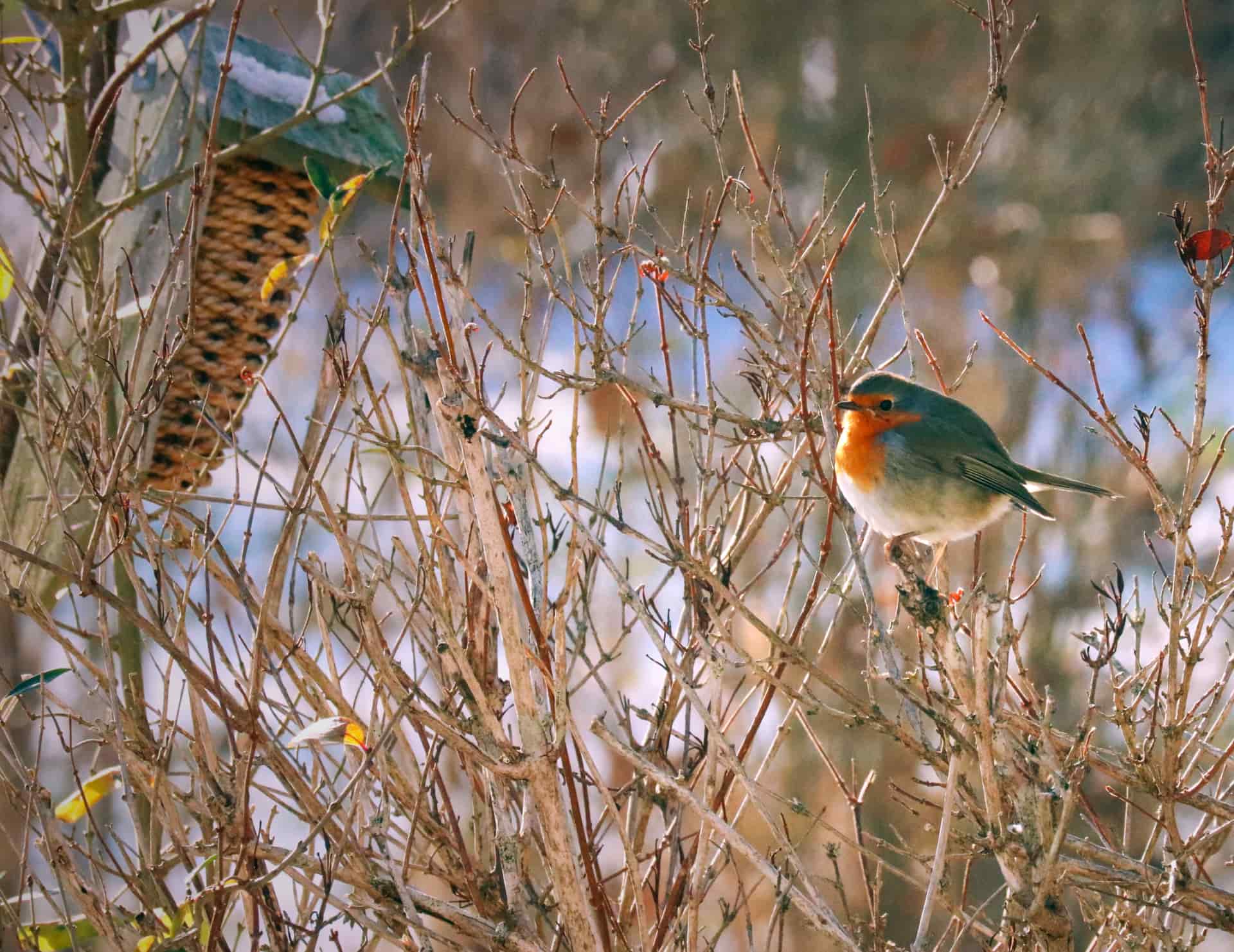
A complete winter station is three feeders, one water source, and cover within about ten feet (cheap feeders are a perfectly good way to reach three): a high-capacity seed feeder, a suet cage, a low platform tray, and open water. Site it about ten feet from dense cover — close enough for an escape route, far enough that a cat cannot launch from it.
Build it in this order
- Pick the site. Sheltered from prevailing wind, about ten feet from cover, visible from a window, and within reach of an outdoor socket if you want water.
- Set the pole, before anything else and before the ground freezes. It fixes where the station can be and which baffles will fit. Which pole, and why the anchor is the spec that matters.
- Put up the seed feeder. High capacity, roofed. This is what gets found first.
- Add the suet cage. Ideally on or near a trunk, several feet from the seed feeder so species are not queuing in one place.
- Add water. The step most yards skip, and the one that changes the visitor list most — and the first thing to try if nothing is visiting.
- Add a window feeder if you want to actually see the birds rather than watch them at a distance. Which ones stay on the glass is mostly a question about the suction cups.
- Add a low tray if you have juncos, doves or cardinals — the platform and ground feeder roundup covers drainage and stability, which are the two specs that matter.
- Add a peanut feeder if woodpeckers and jays are the target. Mesh size decides which birds can use it.
- Add shelter — a brush pile, or a roost box — for the night side of the problem.
The distances
| From | To | Distance | Why |
|---|---|---|---|
| Feeders | Dense cover | About 10 ft | Escape route from hawks; too close gives cats a launch point |
| Feeders | Each other | Several feet | Reduces queuing and lets shy species feed |
| Feeders | Windows | Under 3 ft or over 30 ft | The two zones where window strikes are least likely |
| Feeder | Ground | 5 to 6 ft | Above snow, above easy cat reach |
| Bath | Cover | A little further than the feeders | A drinking bird is distracted and exposed |
The window figure is counter-intuitive and worth acting on: very close to the glass, a bird cannot build up lethal speed; far away, it reads the glass as part of the scene rather than as sky.
Water is the part most stations are missing
Almost everyone puts up feeders. Far fewer put out water, and in a freeze it is the scarcer resource. Seed and suet stay edible under snow; standing water does not stay liquid. The Cornell Lab notes birds get most of their winter water from snow and dripping ice, and melting snow costs a bird body heat — the exact resource you were trying to help it bank.
A drop-in de-icer in a bath you already own is the cheapest way to add it, at roughly $26 to $42 to run for a whole winter. The full arithmetic.
Wind and snow
Site the station in the lee of a hedge, a fence or the house. Three things improve at once: birds are more willing to feed out of the wind, feeders are less likely to be emptied by weather, and any heated water costs less to run because wind is the largest driver of heat loss from an open surface. In the Pacific Northwest, the same sheltered spot is where a heated hummingbird feeder belongs.
Avoid roof drip lines and anywhere snow slides off a roof. A feeder buried under a roof-load of snow is out of service until you dig it out, usually on the coldest morning of the year. More on placement.
Maintenance, honestly
- Clear snow after every fall. Trays and open feeders fill; ports ice over. The maintenance page.
- Rake under the feeders occasionally. Hulls and fat build up and become a rodent draw and a disease risk — or catch it before it lands, which is easier in January than raking snow.
- Wash feeders every few weeks. Mold at feeders is linked to fatal respiratory infection.
- Scrub the bath weekly. Nothing evaporates in winter, and every bird in the yard is drinking from it.
- Check the cord monthly if you are running a de-icer. Safety.
What to buy
Winter Perch is funded by affiliate commission. If you buy through a link on this page we may earn a commission at no extra cost to you, and it never decides a ranking. Full disclosure · how we pick.
Quick picks
Ranked, with the trade-off named. Tap a row for the full write-up; the price button goes straight to Amazon.
| # | Product | Best for | Price |
|---|---|---|---|
| 1 |  Nature's Way CWF19 Cedar Hopper Feeder with Suet Cages, 6 qtSix quarts of seed with a suet cage on each end — the best single answer to the winter refill problem if you are only hanging one thing. | One feeder that runs seed and suet together | Check price on Amazon |
| 2 |  Nature's Way CWF2 Cedar Upside-Down Suet FeederThe cake faces down, so a bird has to hang underneath to eat. Woodpeckers, nuthatches and chickadees do that happily. Starlings largely will not. | Starling exclusion without a mechanism | Check price on Amazon |
| 3 | 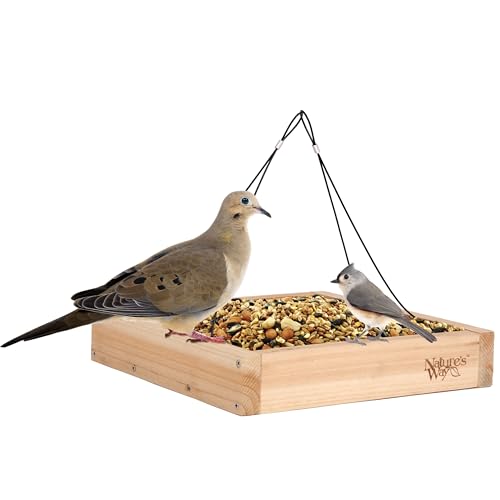 Nature's Way CWF3 Cedar Platform Tray Feeder, 12 x 12 inA flat cedar tray with a screen bottom. Juncos, doves and cardinals feed from flat surfaces and largely ignore tubes. | Ground feeders that will not use a tube | Check price on Amazon |
| 4 |  K&H Super Ice Eliminator Bird Bath De-Icer, 80 WThe 50 W unit with enough extra element to cope with a bigger basin and a colder night. If you are buying one de-icer without measuring anything, buy this one. | Most yards, most winters — the default de-icer | $28.91 · See it on Amazon |
#ad how we are funded · price as of October 15, 2026
The picks in full
Top pick One feeder that runs seed and suet together
Nature's Way CWF19 Cedar Hopper Feeder with Suet Cages, 6 qt
Six quarts of seed with a suet cage on each end — the best single answer to the winter refill problem if you are only hanging one thing.
Specifications
- Seed capacity
- 6 quarts
- Suet
- Integrated cages
- Material
- Cedar
- Roof
- Yes — covers seed and both cages
Trade-offs
- Six quarts is the longest refill interval on this page
- Seed and suet in one visit, which matters when the visit is in a blizzard
- The roof covers everything, so wet seed is much less of an issue
- Cedar, and it looks like furniture rather than kit
- No squirrel exclusion at all — it is a hopper, and hoppers are open
- A full six quarts of damp seed is a lot of seed to spoil at once
- Big and heavy on a hanger
Who it is forThe single-station yard, where one feeder has to do everything.
Skip it ifSkip it if squirrels run your yard. A hopper feeder with no mechanism is the easiest meal on this site.
#ad how we are funded · price as of October 15, 2026
No. 2 Starling exclusion without a mechanism
Nature's Way CWF2 Cedar Upside-Down Suet Feeder
The cake faces down, so a bird has to hang underneath to eat. Woodpeckers, nuthatches and chickadees do that happily. Starlings largely will not.
Specifications
- Capacity
- 1 standard cake
- Orientation
- Downward-facing cake
- Material
- Cedar with roof
- Mechanism
- None — geometry only
Trade-offs
- Excludes most starlings through geometry, with nothing to break or freeze
- The roof keeps snow and rain off the cake
- Cedar body, weathers well
- Clinging birds are the ones you wanted anyway
- It is not perfect — determined starlings learn to hang
- Loading a cake face-down is fiddlier than a front-opening cage
- One cake
Who it is forAnyone whose plain cage feeder has been taken over by starlings or grackles.
Skip it ifSkip it if your main visitors are cardinals and jays, which will not hang upside down. You will have excluded the birds you were feeding.
#ad how we are funded · price as of October 15, 2026
Where these specs came from
No. 3 Ground feeders that will not use a tube
Nature's Way CWF3 Cedar Platform Tray Feeder, 12 x 12 in
A flat cedar tray with a screen bottom. Juncos, doves and cardinals feed from flat surfaces and largely ignore tubes.
Specifications
- Size
- 12" x 12"
- Material
- Cedar with mesh base
- Drainage
- Screen bottom
- Mount
- Hang or set low
Trade-offs
- Reaches the third of your winter list that will not use a tube feeder
- The screen base drains meltwater instead of pooling it
- Takes seed, cracked corn, fruit and suet nuggets equally
- The easiest feeder on this site to clean properly
- An open tray, so snow lands directly in it
- No exclusion of anything — squirrels, starlings and deer all welcome
- Needs clearing after every snowfall
Who it is forYards with ground-feeding regulars, and anyone who has noticed the juncos never land on the tube.
Skip it ifSkip it if you cannot get out to clear it. A tray under six inches of snow is not a feeder, it is a bird-shaped disappointment.
#ad how we are funded · price as of October 15, 2026
No. 4 Most yards, most winters — the default de-icer
K&H Super Ice Eliminator Bird Bath De-Icer, 80 W
The 50 W unit with enough extra element to cope with a bigger basin and a colder night. If you are buying one de-icer without measuring anything, buy this one.
Specifications
- Rated watts
- 80 W
- Form
- Submersible, natural rock shape
- Control
- Automatic
- Finish
- Paintable enamel
- Safety
- Safety listed for outdoor submersible use
Trade-offs
- 80 W is the sweet spot: enough for a 20-inch basin, well under a 150 W bath
- Automatic, so there is no switch to forget
- Same drop-in convenience as the 50 W, same paintable finish
- Works in the bath you already own, at any mount height
- 60 percent more draw than the 50 W for buyers with a small basin who did not need it
- Still a cord in the water
- The rock shape takes up basin space small birds could be standing in
Wattage: 80 W
K&H states 80 watts, and the listing is explicit that the unit is safety listed and automatic. Eighty watts holds a typical 16 to 20 inch basin open through a normal northern winter night.
At full draw for a four-month winter (120 days), plugged in around the clock: 80 W x 2880 h = 230.40 kWh, x $0.1834/kWh = $42.26 — $42.26 at $0.1834/kWh. A thermostatic unit will land under that.
Who it is forThe default buyer: an existing 16 to 20 inch bath, a normal northern winter, no interest in replacing the bath itself.
Skip it ifSkip it if your basin is under about 14 inches. The 50 W version does that job and costs less to run every single day of the winter.
#ad how we are funded · price as of October 15, 2026
How we picked
- Placement distances drawn from standard feeder-siting guidance and stated with the reason attached.
- Capacity prioritized, because refill interval is what determines whether a station stays stocked in February.
- Water treated as a component, not an accessory, with its running cost published rather than asserted.
- Live price and availability on every pick, refreshed daily.
We have not tested any of these. What we did instead: read the manufacturers’ own listings, compiled the published specifications, computed the running cost at a cited electricity rate, and refreshed the prices daily. The full method is published.
The individual rankings: seed feeders, suet feeders, de-icers and roost boxes. The seasonal version of this page is the winter yard checklist.
Questions people actually ask
- How far should bird feeders be from cover?
- About ten feet. Close enough that birds have an escape route from a hawk, far enough that a cat cannot launch from the cover onto the feeder.
- How many feeders do I need?
- Three covers a northern yard: a high-capacity seed feeder, a suet cage, and a low platform tray for the ground feeders. Add water and you have the complete setup.
- How far should feeders be from windows?
- Either under three feet or over thirty. Very close, a bird cannot build up lethal speed; far away, it reads the glass as part of the scene rather than as open sky.
- Should I move feeders in winter?
- Site them once, in the lee of wind, and leave them. Birds learn locations, and moving a feeder in midwinter costs you traffic for several days.
- Do I really need water as well as feeders?
- It is the part most stations are missing and arguably the scarcer resource in a freeze. Melting snow costs a bird body heat, which is the exact energy you were helping it bank by feeding it.
Sources
Read next
- The Best Bird Feeders for Winter
Seed feeders ranked on capacity, roofing and drainage — the specs that decide how often you go out in bad weather.
- The Best Bird Bath De-Icers
Five drop-in de-icers from 50 W to 250 W, matched to basin size, with the running cost worked out for each.
- The Best Roosting Boxes for Winter
Four winter roost boxes ranked on wall thickness, entrance height and internal perches — with honest expectations about occupancy.
- Feeder Placement in Snow and Wind
Wind shelter, drift lines, roof drip and height above snow — where to hang a feeder so the weather does not close it.