Winter feeders / Roundup
The Best Bird Feeder Poles for Winter
Half this site tells you to put the feeder on a pole and fit a baffle. This is the page about which pole — ranked on the spec that decides everything else, which is how it goes into the ground.
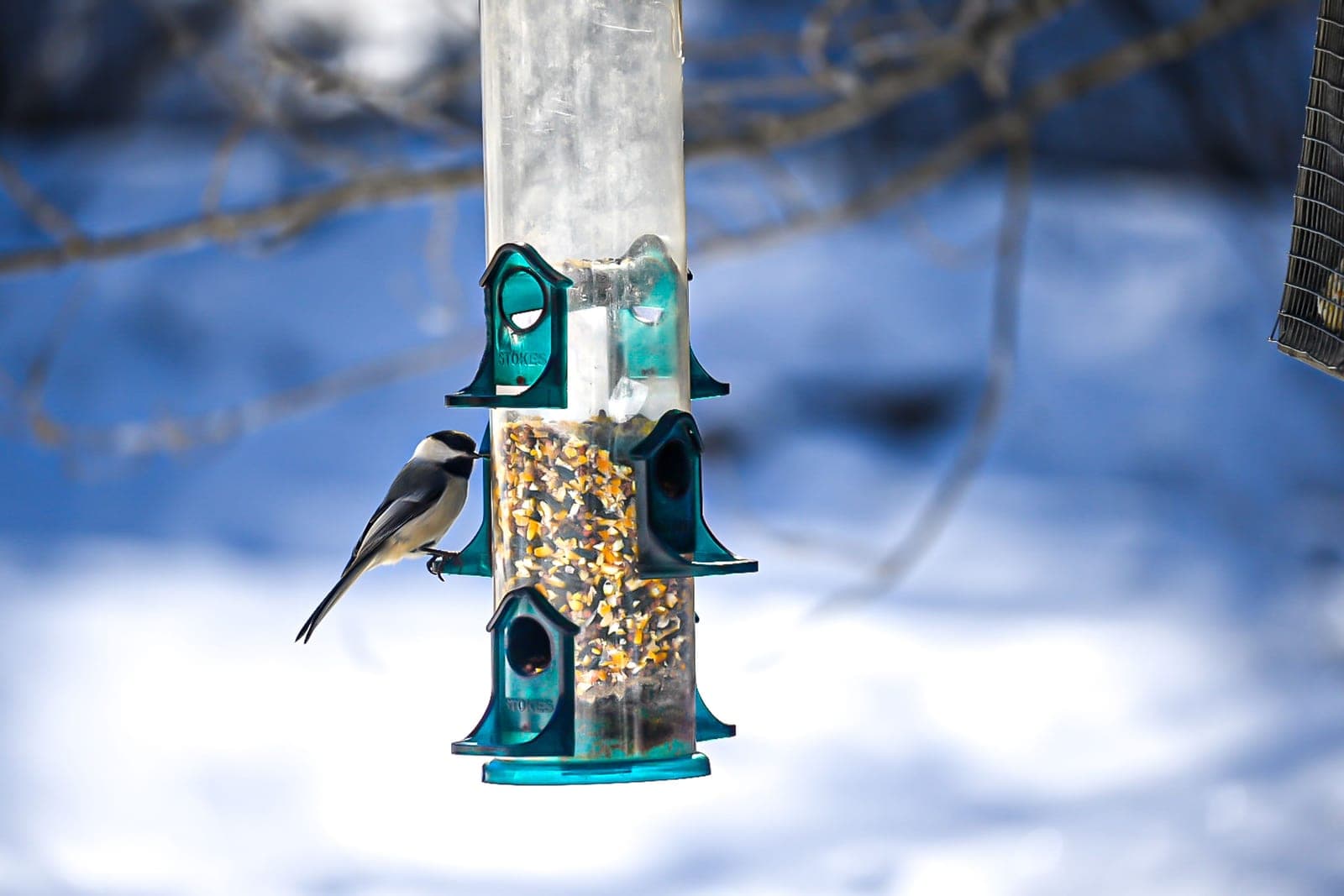
Buy a pole with a screw-in ground auger, not a step-in prong base — that single spec decides whether the station is still upright in March. The Squirrel Stopper Sequoia is the complete answer because the baffle comes with it and is sized to the pole. And install it before the ground freezes, because after that your options narrow to a deck clamp.
Winter Perch is funded by affiliate commission. If you buy through a link on this page we may earn a commission at no extra cost to you, and it never decides a ranking. Full disclosure · how we pick.
Quick picks
Ranked, with the trade-off named. Tap a row for the full write-up; the price button goes straight to Amazon.
| # | Product | Best for | Price |
|---|---|---|---|
| 1 | Squirrel Stopper Sequoia Pole Kit, 4 stationsEight foot two above ground on a 1-1/4 inch 16-gauge pole, four arms at 19 inches of reach, a ground auger, and the baffle already fitted. The one purchase that ends the squirrel argument. | The complete answer, baffle included | Check price on Amazon |
| 2 | Erva FP5TLM4B 4-Arm Premium Feeder Pole SetA sectional made-in-USA pole on a twist-in ground socket, in tubing the maker states is nearly twice the industry-standard wall thickness. The system you extend rather than replace. | Buying once, and adding to it later | Check price on Amazon |
| 3 | Squirrel Stopper Deluxe SQC05 Pole and BaffleA 2-inch galvanized pole on a two-foot auger, rated to eight feeders at 30 lb an arm, with a spring-loaded inverted-cone baffle. Overkill for three feeders and exactly right for eight. | A large station, and raccoons | Check price on Amazon |
| 4 | Erva 80 in 3-Arm Feeder Pole Set with Ground SocketThe three-arm version of the same twist-in system. Three feeders is what most yards actually run, and this costs less than the four-arm set for the same steel. | The same build quality, three arms | Check price on Amazon |
| 5 | Gray Bunny 91 in Bird Feeder Pole Set, 7 attachmentsNinety-one inches, four hooks and seven accessories including a bath dish, a mesh tray and a suet cage, on a five-prong step-in base. The most equipment per dollar here, and the least anchoring. | The cheapest complete station | Check price on Amazon |
| 6 | Gray Bunny 65 in Shepherd's Hooks, 4 packNon-hollow steel hooks with long base prongs, four in a box. The right purchase for spreading single feeders around a yard, and the wrong one for stopping anything climbing. | One feeder, no squirrel problem | Check price on Amazon |
| 7 | Gray Bunny 37 in Deck Hook with Non-Slip ClampA clamp-on rail hook, no ground involved. The answer for a balcony, a deck, or a yard where you have left the pole decision until January. | Ground that is frozen, rented, or paved | Check price on Amazon |
#ad how we are funded · no live price right now
The picks in full
Top pick The complete answer, baffle included
Squirrel Stopper Sequoia Pole Kit, 4 stations
Eight foot two above ground on a 1-1/4 inch 16-gauge pole, four arms at 19 inches of reach, a ground auger, and the baffle already fitted. The one purchase that ends the squirrel argument.
Specifications
- Height above ground
- 8 ft 2 in
- Pole diameter
- 1-1/4 in
- Material
- 16-gauge tubular steel
- Hanging stations
- 4, at 19 in from the pole
- Anchor
- Screw-in ground auger
- Baffle
- Included — patented, moves up, down and sideways
Trade-offs
- The auger is the winter spec: it screws in and holds, where a step-in prong base works loose as ground freezes and thaws
- Baffle is included and sized to the pole, so there is no compatibility guesswork
- 19 inches of reach per arm keeps a feeder far enough out that a squirrel cannot lean across from the pole
- 16-gauge steel carries four loaded feeders plus wet snow without bowing
- 8 ft 2 in is tall enough to fit a baffle at the right height and still reach the feeders
- The maker states it needs installing at least ten feet from any pole or wall — most yards cannot give it that, and without it the baffle is decoration
- Four stations is the ceiling; if you already run six feeders you will want the Deluxe instead
- An auger goes into soft ground easily and rocky ground badly, and you find out which you have while installing it
- Priced as a system, so it is a real outlay against a bare shepherd's hook
Who it is forAnyone starting a feeding station from nothing who would rather buy the pole and the baffle once than assemble them from parts.
Skip it ifSkip it if your only clear ground is within jumping distance of a fence, a wall or a low branch. Move the station first — no baffle on any pole survives a squirrel that lands above it.
#ad how we are funded · no live price right now
No. 2 Buying once, and adding to it later
Erva FP5TLM4B 4-Arm Premium Feeder Pole Set
A sectional made-in-USA pole on a twist-in ground socket, in tubing the maker states is nearly twice the industry-standard wall thickness. The system you extend rather than replace.
Specifications
- Pole height
- 80 in (98 in overall in-ground height)
- Pole diameter
- 1 in
- Construction
- 6-piece sectional
- Arms
- 4, forged twist
- Anchor
- Twist-in ground socket
- Origin
- Made in USA
Trade-offs
- Wall thickness is the spec Erva competes on, and it is the one that decides whether a pole bows under a snow-loaded feeder
- A twist-in socket means the pole lifts out of the socket — you can bring it in, move it, or swap the top without re-digging
- 1-inch diameter is the size most aftermarket baffles are built for, so you are not locked to one accessory
- Sectional, so you can extend it or change the arm top rather than buying a second pole
- Made in USA, and Erva is the one maker in this category that publishes real numbers
- No baffle included — budget for one separately, and it is not optional if you have squirrels
- 1 inch is the narrowest pole here; fine for four feeders, less happy carrying eight
- A sectional pole has joints, and joints are where a pole develops a lean over a wet winter
- Assembly is more involved than a one-piece hook
Who it is forSomeone building a station deliberately who wants a pole that accepts standard baffles and can be extended.
Skip it ifSkip it if you want one box that solves squirrels today. This is a pole, not a system — the baffle is a second purchase and a second decision.
#ad how we are funded · no live price right now
No. 3 A large station, and raccoons
Squirrel Stopper Deluxe SQC05 Pole and Baffle
A 2-inch galvanized pole on a two-foot auger, rated to eight feeders at 30 lb an arm, with a spring-loaded inverted-cone baffle. Overkill for three feeders and exactly right for eight.
Specifications
- Height
- 8 ft
- Pole diameter
- 2 in
- Material
- 16-gauge galvanized steel, powder-coated
- Capacity
- Up to 8 feeders, 30 lb per arm
- Arm spread
- 36 in overall
- Anchor
- 2 ft screw-in auger
- Baffle
- Included — spring-loaded inverted cone
Trade-offs
- Galvanized under the powder coat, which is the finish that matters where snow sits against steel for months
- A two-foot auger is the most secure anchor in this roundup and the one least likely to lean by March
- The stated 30 lb per arm covers a full 5 lb seed feeder plus a load of wet snow with margin left
- The spring-loaded cone is aimed at raccoons, not just squirrels — a genuinely higher bar
- A 2-inch pole will not accept the many baffles sold for 1 to 1-1/4 inch poles, so you are committed to the one it ships with
- Eight stations is more than most yards should run — crowding feeders concentrates birds and speeds disease transmission
- The heaviest and most expensive option here, and the hardest to relocate once the auger is in
- Two feet of auger into stony or root-filled ground is genuine work
Who it is forA large, permanent station where raccoons are part of the problem and not just squirrels.
Skip it ifSkip it if you run two or three feeders. You are paying for capacity you will not use and giving up compatibility with every aftermarket baffle on the market.
#ad how we are funded · no live price right now
No. 4 The same build quality, three arms
Erva 80 in 3-Arm Feeder Pole Set with Ground Socket
The three-arm version of the same twist-in system. Three feeders is what most yards actually run, and this costs less than the four-arm set for the same steel.
Specifications
- Pole height
- 80 in
- Arms
- 3
- Anchor
- Twist-in ground socket
- Build
- Heavy duty, per the listing
Trade-offs
- Three feeders is the realistic number for most yards, and paying for a fourth arm you leave empty is waste
- Same twist-in socket, so the pole still lifts out without re-digging
- Erva's arms are sold separately, so a fourth station later is an add-on rather than a new pole
- No baffle included, same as the four-arm set
- Three arms means three feeders, and a station tends to grow rather than shrink
- Erva's listings are plainer than the big-brand systems — you get steel, not a package
Who it is forA three-feeder station where build quality matters more than an included accessory bundle.
Skip it ifSkip it if you know you want four or more stations. The four-arm set is the cheaper route to that than this plus an added arm.
#ad how we are funded · no live price right now
No. 5 The cheapest complete station
Gray Bunny 91 in Bird Feeder Pole Set, 7 attachments
Ninety-one inches, four hooks and seven accessories including a bath dish, a mesh tray and a suet cage, on a five-prong step-in base. The most equipment per dollar here, and the least anchoring.
Specifications
- Height
- 91 in
- Hooks
- 4
- Included accessories
- 7 attachments
- Base
- 5-prong step-in
- Hanger
- Stainless steel
- Model
- GB-6844D
Trade-offs
- A whole station in one box for the price of a bare pole from the specialist makers
- The included tray and suet cage are genuinely useful rather than filler
- Stainless hanger will not rust-streak the pole over a wet winter
- Light enough to reposition while you work out where birds actually want it
- A five-prong step-in base, not an auger — that is the whole trade, and it is the wrong end of it for winter
- At roughly 5 lb, the pole is light for its height; four loaded feeders and a gust is a lot to ask of a prong base
- Prongs must go in before the ground freezes. Into frozen ground they will not seat at all
- Thinner steel than the specialist poles, and it can bow under a snow-loaded feeder
- No baffle, and a light pole with a step-in base is the worst candidate for adding one — a climbing raccoon can rock it loose
Who it is forA first station on a budget, set up in autumn on soft ground, in a spot out of the worst wind.
Skip it ifSkip it if the ground is already hard, if your yard is exposed, or if squirrels are the reason you are shopping. On all three counts an auger pole is the honest answer.
#ad how we are funded · no live price right now
No. 6 One feeder, no squirrel problem
Gray Bunny 65 in Shepherd's Hooks, 4 pack
Non-hollow steel hooks with long base prongs, four in a box. The right purchase for spreading single feeders around a yard, and the wrong one for stopping anything climbing.
Specifications
- Height
- 65 in
- Quantity
- 4
- Construction
- Non-hollow, non-adjustable
- Base
- Extra-long prongs
Trade-offs
- Non-hollow steel is meaningfully stiffer than the hollow tube most cheap hooks use
- Four hooks spreads feeders around a yard, which reduces crowding at any one of them
- No assembly, and easy to move as you learn where birds prefer to feed
- By far the cheapest way to get a feeder off the ground and away from cover
- 65 inches is too short to baffle properly — a squirrel reaches over a baffle fitted low enough to leave you room to fill the feeder
- Prongs into frozen ground do not go, so these must be sited before the freeze
- One feeder per hook, and no way to add a second station later
- A hook loaded with a heavy feeder will lean over a wet winter and needs straightening
Who it is forSpreading two or three single feeders around a yard where squirrels are not the problem you are solving.
Skip it ifSkip it if squirrels are why you are reading this. A shepherd's hook is not a squirrel solution at any price — you need pole height, an auger and a baffle, and this has none of the three.
#ad how we are funded · no live price right now
No. 7 Ground that is frozen, rented, or paved
Gray Bunny 37 in Deck Hook with Non-Slip Clamp
A clamp-on rail hook, no ground involved. The answer for a balcony, a deck, or a yard where you have left the pole decision until January.
Specifications
- Reach
- 37 in
- Mount
- Non-slip deck rail clamp
- Anchor
- None — clamps to a rail
- Model
- GB-6819
Trade-offs
- Works in frozen ground, on concrete, and on a rented balcony, because it does not touch the ground at all
- Installs in a minute with no digging, which matters in the season this site is about
- Puts the feeder at eye level from indoors, which is where most winter birding actually happens
- Removes cleanly, so nothing is left behind at the end of a tenancy
- A deck rail is a squirrel highway — this puts the feeder on the one route you cannot baffle
- 37 inches of reach is a long lever on a clamp; a heavy feeder plus snow will test it
- Seed and droppings land on the deck below, and in winter that freezes into the boards
- One feeder, and a rail you may not want a feeder on
Who it is forAnyone without ground to work with, or anyone who wants water and food up now while the pole waits for spring.
Skip it ifSkip it if you have soft ground and time before the freeze. A pole with an auger and a baffle is better in every way except installation speed.
#ad how we are funded · no live price right now
Install it now, or buy a clamp
This is the most useful sentence on the page and it has nothing to do with which pole you choose.
Every ground-mounted pole here — auger or prong — has to go into ground that will take it. Once the top several inches are frozen, an auger will not turn and prongs will not seat. You are not going to force either with a mallet without bending something. So the pole decision is an autumn decision, and if you are reading this in January the honest answer is the deck clamp until spring.
How it anchors: the spec that matters most
Three designs, and they are not close to equivalent once weather is involved.
| Anchor | How it holds | Winter behavior |
|---|---|---|
| Screw-in auger | Threads bite the soil column, resisting lift and lean | Best. Holds through freeze-thaw; the one anchor that survives a loaded pole in wind |
| Twist-in ground socket | A socket goes in; the pole drops into it | Very good, and the pole lifts out for cleaning or relocation without re-digging |
| Step-in prong base | Three to five prongs pushed in underfoot | Weakest. Works loose over repeated freeze-thaw and will not seat in hard ground |
| Deck rail clamp | Clamps to an existing rail | Ground-independent, so it works in February — but it sits on a squirrel highway |
Freeze-thaw is the mechanism people underestimate: water in the soil expands as it freezes and lifts whatever is in it, then the thaw leaves the hole slightly larger. Repeat that thirty times over a winter and a prong base is standing in a socket of its own making.
Diameter is a compatibility spec
The instinct is to read pole diameter as strength. It matters more as fit, because a baffle is sold for a stated diameter and a baffle that does not seal against the pole is a baffle with a gap.
- 1 inch — the size most aftermarket baffles are built for. Widest accessory choice.
- 1-1/4 inch — common on complete systems, which normally ship the matching baffle.
- 2 inch — heavy-duty, and largely outside the aftermarket baffle range. You use the one it came with.
So the decision branches early: buy a system where the baffle is included and matched, or buy a pole at a diameter the aftermarket serves and choose the baffle yourself. Both are defensible. Buying a wide pole and then shopping for a baffle is the route that ends in returns. Which baffle designs actually stop anything covers the hardware side in full.
Height, and why a 65-inch hook cannot be baffled
A baffle has to sit high enough that an animal cannot reach over it from the ground — call it four to five feet up — and the feeder has to hang clear above the baffle. That is most of six feet before you have hung anything.
A 65-inch shepherd's hook is five feet five. There is no arrangement of that height that gives you a correctly positioned baffle and a feeder you can still reach to fill. This is not a criticism of shepherd's hooks — they are good at what they do. It is the reason they are not a squirrel solution, and no amount of money spent on a nicer one changes the arithmetic.
The clearance rule applies to poles too
A baffle blocks the climb. It does nothing about the jump. Squirrel Stopper's own instructions say to install at least ten feet from any other pole or wall — a manufacturer telling you plainly that the product does not work in a tight yard, which is more honest than most listings manage.
Measure that distance before you buy anything. If your only clear ground is three feet from a fence, the pole is not the problem and no pole is the solution. Move the station, or accept that you are feeding squirrels and enjoy them.
Load: it is not the feeders, it is the snow
A 5 lb seed feeder is not much. A 5 lb seed feeder with a roof full of wet snow, on a 19-inch arm, in a gust, is a bending moment — and four of those on one pole is how a light pole ends the winter with a lean.
- Gauge over diameter for stiffness. 16-gauge steel is the number worth looking for; wall thickness is what resists bowing.
- Published load ratings are rare and useful. A stated 30 lb per arm tells you the maker has thought about it.
- Clear snow off feeder roofs when you clear everything else — keeping feeders clear of snow and ice is about the seed, but it takes the load off the pole too.
- Check the pole for lean after storms, because a leaning pole has a baffle that no longer sits level, and a baffle that is not level is a ramp.
Finish, because snow sits
In summer a pole gets wet and dries. In winter snow banks against the base and stays there for weeks, and meltwater runs down into the ground socket. Galvanized steel under a powder coat is the finish that handles that; a painted finish over bare steel is the one that shows rust streaks by the second season. It is a minor spec against anchoring, and it is the reason two otherwise-identical poles are priced differently.
Where to actually put it
Ten feet from anything jumpable, out of the prevailing wind, and roughly ten feet from cover — close enough that birds have an escape route, far enough that a cat has nowhere to wait. Those three constraints usually intersect in exactly one spot in a yard, which is why finding it before you dig matters. Feeder placement in snow and wind works through the trade-offs, and the feeding station setup guide covers what goes on the pole once it is in.
What we would skip
What we would skip
A step-in prong base, if you can afford an auger
Freeze-thaw lifts a prong base a little at a time and leaves a slightly wider hole each cycle. By late winter a loaded pole leans, and a leaning pole has a tilted baffle, which is a ramp. The auger is the single upgrade worth paying for in this category.
A shepherd's hook as a squirrel solution
At 65 inches there is no way to fit a baffle high enough to work and still leave the feeder reachable. Shepherd's hooks are good for spreading single feeders around a yard. They are not, at any price, an exclusion method.
Any pole within jumping distance of a fence, wall or branch
Squirrel Stopper's own instructions specify ten feet of clearance. A baffle blocks the climb and does nothing about the leap. If the yard cannot give the pole that space, no pole on this page will help.
A 2-inch pole if you already own a baffle
Most aftermarket baffles are made for 1 to 1-1/4 inch poles. Going wide commits you to whatever the system shipped with, which is fine when that is a good baffle and expensive when it is not.
Setting a pole in concrete
It feels like the thorough option and it is the one you will regret. Feeding stations get moved — for light, for wind, for a sightline from a window, or because the clearance turned out to be wrong. An auger or a ground socket comes back out.
Buying the pole in January
Frozen ground takes neither an auger nor prongs, and forcing either bends hardware. If the ground has gone, use a deck clamp for this season and set the pole properly in autumn.
Where this fits
A pole is the piece of hardware the rest of the station hangs off. The feeding station guide covers what to put on it, predator guards covers the baffle in detail, and squirrel-proof suet feeders covers the feeders that help once the pole is doing its job. A pole is also the correct mount for a heated bath, though that one brings a cord with it.
Questions people actually ask
- What is the best bird feeder pole for winter?
- One anchored with a screw-in auger rather than a step-in prong base. The Squirrel Stopper Sequoia is the strongest complete answer because the auger and a matched baffle come with it; the Erva sets are the better choice if you want to pick your own baffle.
- Can you put a bird feeder pole in frozen ground?
- No. An auger will not turn and prongs will not seat once the top several inches have frozen, and forcing either bends the hardware. Set the pole in autumn. If the ground has already gone, use a deck rail clamp for the season.
- How tall should a bird feeder pole be?
- Tall enough for a baffle at four to five feet with the feeder hanging clear above it, so roughly eight feet. That is why a 65-inch shepherd's hook cannot be baffled properly — there is no room for both.
- Does a shepherd's hook stop squirrels?
- No. It is too short to position a baffle correctly and still leave the feeder reachable. Shepherd's hooks are useful for spreading single feeders around a yard where squirrels are not the problem you are solving.
- What diameter bird feeder pole do I need?
- One inch if you want the widest choice of aftermarket baffles, or 1-1/4 inch on a complete system that ships its own matched baffle. Two-inch poles are heavy duty but fall outside most aftermarket baffle ranges.
- Should I set a feeder pole in concrete?
- No. Feeding stations get moved — for wind, for light, for a window sightline, or because the clearance was wrong. An auger or twist-in ground socket holds well and comes back out.
Sources
Read next
- How to Set Up a Winter Bird Feeding Station
The complete winter station: feeders, water and cover, with the distances and the order to build it in.
- Feeder Placement in Snow and Wind
Wind shelter, drift lines, roof drip and height above snow — where to hang a feeder so the weather does not close it.
- Predator Guards for Nest and Roost Boxes
Stovepipe pole baffles and entrance portal guards, ranked — plus the clearance rule that decides whether any of them work.
- Squirrel-Proof Suet Feeders
Weight-activated feeders, pepper cakes and baffles compared — what actually stops a committed squirrel.