Winter birding / Guide
Where to Go Winter Birding
Winter concentrates birds into a few habitat types. Learn the types and you can find birds anywhere — including in a state this page does not mention.
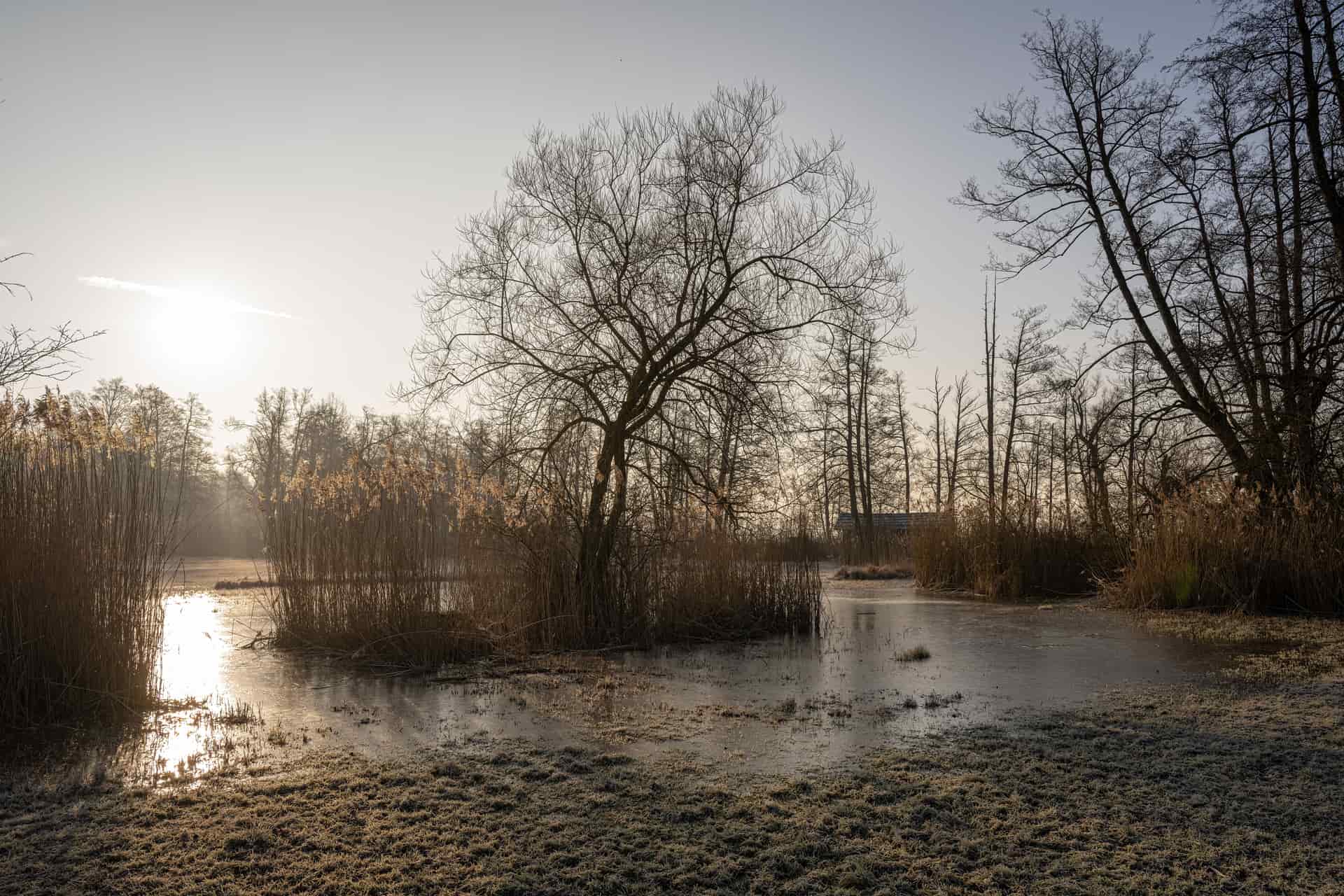
Winter concentrates birds into a short list of habitat types: open water in a frozen landscape, coastline, stubble and weedy field margins, fruiting shrubs, and sheltered south-facing woodland edge. Find the type and you have found the birds, regardless of which state you are in. Open water and coastline are also the two habitats where a spotting scope stops being a luxury — the birds are there, sitting still, and too far off for binoculars.
The habitat types, in order of reliability
1. Open water in a frozen landscape
The most productive winter habitat there is. When everything else freezes, anything that needs open water concentrates on what remains: river bends that stay unfrozen, spring-fed ponds, power station outflows, the ice edge on a large lake. Waterfowl, gulls, herons, kingfishers, and often a raptor watching them.
The same principle is why a heated bath works so well in a yard. Open water in a frozen landscape is a signal visible from a long way off.
2. Coastline
Salt water does not freeze at the temperatures inland fresh water does, so coastal habitat stays open all winter and holds enormous numbers of birds. Sea ducks, loons, grebes, gulls, and shorebirds on the exposed flats. Coastal birding in January is often the best birding of the year.
Dress for it. Coastal wind in winter is a different proposition from inland cold, and staying out long enough is the entire skill.
3. Stubble, weedy margins and grassland
Unploughed stubble and weedy field edges hold seed all winter, and sparrows, buntings, larks and finches work them in flocks. Grassland also holds voles, which holds raptors: rough-legged hawks, short-eared owls, harriers quartering low at dusk.
4. Fruiting shrubs and trees
Crab apple, holly, hawthorn, sumac, juniper. Fruit persists into winter and attracts birds that ignore seed entirely — robins, waxwings, thrushes. A single heavily-fruiting tree can hold a flock for days, and finding one is a good use of a January afternoon.
5. Sheltered south-facing woodland edge
Warmer than the surrounding landscape, so more insect activity and more birds. Mixed flocks — chickadees, titmice, nuthatches, kinglets, downy woodpeckers — move through together. Follow the noise; find one and you have found six species.
State notes
These are habitat and season notes rather than specific site recommendations. For particular locations, your state Audubon chapter and eBird's hotspot data are more current and more local than anything we could publish.
| Region | Winter draw |
|---|---|
| Massachusetts | Coastline is the story. Open salt water all winter holds sea ducks, loons, grebes and gulls, with exposed flats for shorebirds. Inland reservoirs hold waterfowl until they freeze. |
| Minnesota | Northern-tier winter, which means northern birds. Boreal species come south, and irruption years can bring finches in numbers. Open water is scarce and therefore concentrates birds hard. |
| Arizona | The opposite proposition: mild winters and a large influx of wintering species. Desert washes, riparian corridors and agricultural fields, with sparrow and raptor diversity that is hard to match. |
| Texas | The Gulf coast and the lower Rio Grande valley are among the strongest winter birding regions in the country, combining resident subtropical species with a large wintering influx. |
| New York City | Better than people expect. Coastal parks, harbor waters that stay open, and large urban parks that concentrate birds because there is nowhere else to go. Waterfowl on open water and owls in the larger parks. |
Winter birding quality tracks two things everywhere: how much open water there is, and how much unploughed seed-bearing habitat survives. Everything above is a variation on those.
How to find sites near you
- eBird hotspots. Real, current, submitted-by-birders data on what is being seen where. The single best tool for this, and free.
- Your state Audubon chapter. Local knowledge, and often organized winter walks.
- Satellite view. Look for water that stays dark when everything around it is white, and for unploughed field margins.
- Christmas Bird Counts. A century of data on where birds are in winter, and a way to get out with people who know the sites.
The best winter patch is usually your own yard
Worth saying plainly, because it is true and it is the least glamorous advice on this page. A stocked feeding station with open water will show you more species, more often, in worse weather, than most driving you will do. The setup guide.
What to take
Winter Perch is funded by affiliate commission. If you buy through a link on this page we may earn a commission at no extra cost to you, and it never decides a ranking. Full disclosure · how we pick.
Quick picks
Ranked, with the trade-off named. Tap a row for the full write-up; the price button goes straight to Amazon.
| # | Product | Best for | Price |
|---|---|---|---|
| 1 |  Nikon PROSTAFF P3 8x42 BinocularsO-ring sealed and nitrogen purged, which is the spec that matters when you carry glass from a cold yard into a warm kitchen twice a day. | Winter birding, because of the nitrogen purge | $156.95 · See it on Amazon |
| 2 |  Celestron Nature DX 8x42 BinocularsA 7.4-degree field on fully multi-coated BaK-4 glass, waterproof and fogproof — the widest view in this group, and width is what finds a chickadee in a thicket. | The widest field of view at this price | $129.00 · See it on Amazon |
#ad how we are funded · price as of October 15, 2026
The picks in full
Top pick Winter birding, because of the nitrogen purge
Nikon PROSTAFF P3 8x42 Binoculars
O-ring sealed and nitrogen purged, which is the spec that matters when you carry glass from a cold yard into a warm kitchen twice a day.
Specifications
- Configuration
- 8x42
- Field of view
- 377 ft at 1,000 yd
- Sealing
- O-ring sealed, nitrogen purged
- Body
- Rubber armored
- Eye relief
- Long — works over glasses
Trade-offs
- Nitrogen purging stops internal fogging on the cold-to-warm transition that defines winter birding
- 377 ft of field makes finding a moving bird in bare branches far easier
- 8x is steady in gloved, cold hands where 10x is not
- Long eye relief means it works with spectacles on
- 42 mm objectives are bulky for a coat pocket
- 8x is not enough reach for distant waterfowl
- The rubber armor stiffens noticeably in deep cold
Who it is forThe main pair for backyard and local winter birding.
Skip it ifSkip it if you mostly scan a frozen lake for ducks at range. You want 10x and a tripod, not 8x42.
#ad how we are funded · price as of October 15, 2026
No. 2 The widest field of view at this price
Celestron Nature DX 8x42 Binoculars
A 7.4-degree field on fully multi-coated BaK-4 glass, waterproof and fogproof — the widest view in this group, and width is what finds a chickadee in a thicket.
Specifications
- Configuration
- 8x42
- Field of view
- 7.4 degrees
- Prisms
- BaK-4
- Coatings
- Fully multi-coated
- Sealing
- Waterproof and fogproof
Trade-offs
- 7.4 degrees is a wide field, and width beats magnification for feeder birding
- BaK-4 prisms with full multi-coating at an entry price
- Waterproof and fogproof, so winter condensation is handled
- Rubber armored body survives being set down on a frozen deck rail
- Edge sharpness falls off before the Nikon's does
- Celestron lists several near-identical Nature DX variants, which makes buying confusing
- The focus wheel is stiffer in cold than the Nikon's
Who it is forA first serious pair, where field of view matters more than last-ten-percent sharpness.
Skip it ifSkip it if you already own decent glass. The upgrade from a competent entry pair to this one is small; the upgrade to genuinely good optics is a different budget entirely.
#ad how we are funded · price as of October 15, 2026
How we picked
- Organized by habitat type rather than by site list, because habitat transfers and a site list goes stale.
- State notes describe habitat and season, not specific locations — eBird and local Audubon chapters are more current than we could be, and we point at them rather than pretending otherwise.
- No claimed site visits. We have not birded these places and do not imply that we have.
We have not tested any of these. What we did instead: read the manufacturers’ own listings, compiled the published specifications, computed the running cost at a cited electricity rate, and refreshed the prices daily. The full method is published.
Field craft for staying out in it: winter birding tips. What is likely to be in the yard when you get back: winter backyard birds.
Questions people actually ask
- Where is the best place to go birding in winter?
- Anywhere with open water in a frozen landscape, or a coastline. Both concentrate birds hard, because open water is the scarcest resource in a freeze.
- Is winter birding good on the coast?
- Very. Salt water does not freeze at the temperatures inland water does, so coastal habitat stays open and holds sea ducks, loons, grebes, gulls and shorebirds all winter.
- How do I find winter birding spots near me?
- eBird hotspots are the best tool — current, local, and submitted by birders. Your state Audubon chapter and Christmas Bird Count data are the other two.
- What is an irruption year?
- A winter when the northern seed crop fails and boreal finches — siskins, redpolls, grosbeaks — move far south of their usual range. They are unpredictable, so keep a feeder stocked rather than trying to forecast one.
- Do I need to travel to see winter birds?
- No. A stocked feeding station with open water will show you more species, more often, in worse weather, than most of the driving you would do.
Sources
Read next
- Winter Birding Tips
Why winter birding is easier than it looks, how to stay out long enough to enjoy it, and where the birds concentrate.
- The Best Binoculars for Winter Birding
Why 8x42 and nitrogen purging are the winter answer, and two pairs worth the money — plus the honest note about our keyword data.
- Winter Backyard Birds: Who Shows Up, and What Brings Them
The regular winter feeder cast, what each species eats, and the specific feeder or food that brings each one in.
- How to Set Up a Winter Bird Feeding Station
The complete winter station: feeders, water and cover, with the distances and the order to build it in.