Winter feeders / Guide
Keeping Raccoons Off Bird Feeders
The feeder is empty in the morning, or on the ground, or gone. Raccoons are a different problem from squirrels, and most of the hardware sold for squirrels is the wrong size for one.
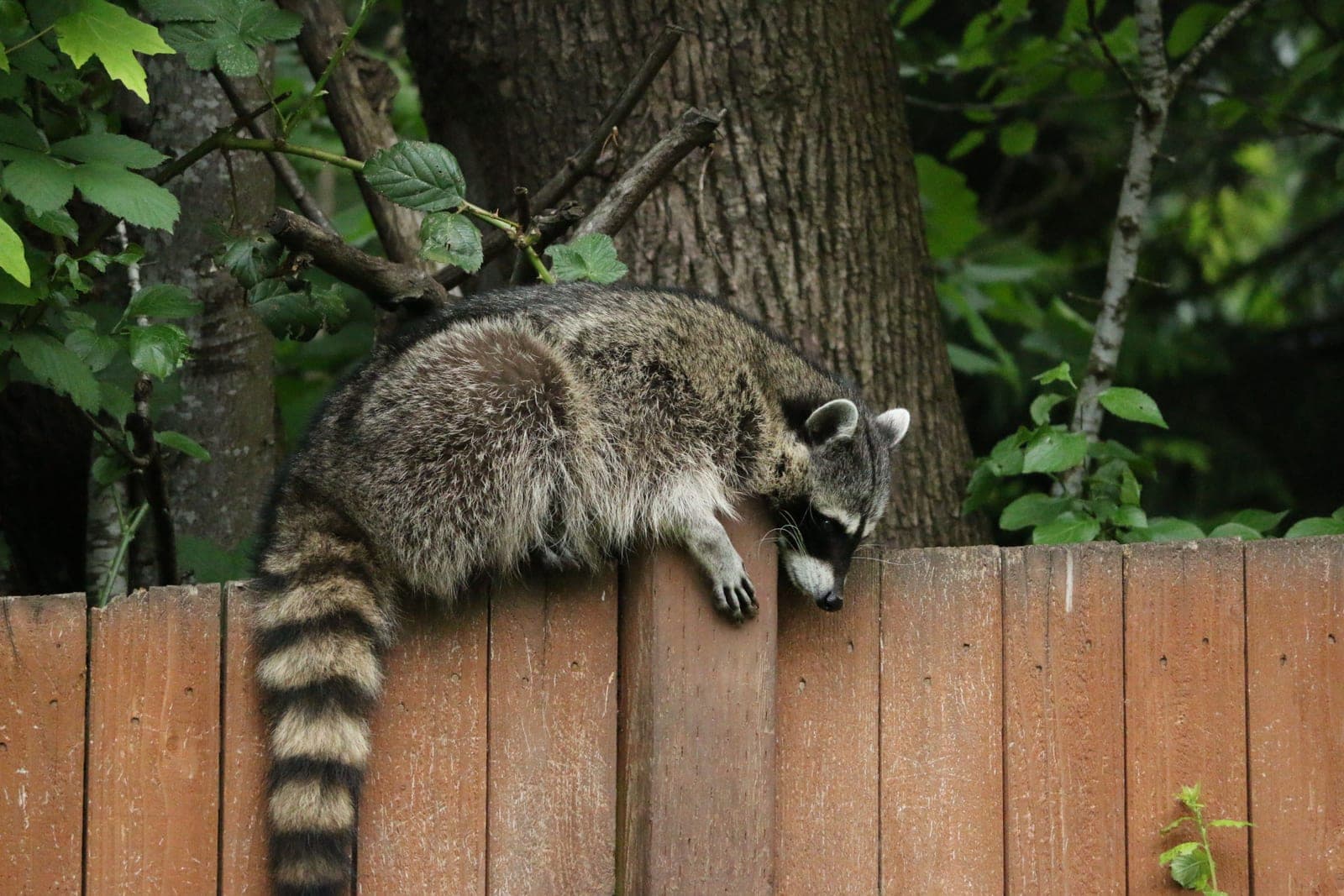
Bring the feeders in at night. Raccoons feed after dark, so a feeder that is indoors at dusk is a feeder they cannot reach — and it costs nothing. If you will not do that, the hardware answer is a cylinder baffle at least 24 inches long, mounted around 4 to 4.5 feet up, on a pole standing 8 to 10 feet from anything climbable. Most baffles sold for squirrels are shorter than that, and a raccoon climbs straight past them.
Winter Perch is funded by affiliate commission. If you buy through a link on this page we may earn a commission at no extra cost to you, and it never decides a ranking. Full disclosure · how we pick.
Quick picks
Ranked, with the trade-off named. Tap a row for the full write-up; the price button goes straight to Amazon.
| # | Product | Best for | Price |
|---|---|---|---|
| 1 |  Songbird Essentials Predator Defeater Raccoon Baffle, 24" x 8"A 24-inch cylinder, which is the length the raccoon guidance actually calls for — most baffles sold for squirrels are far shorter and a raccoon simply climbs past them. | Meeting the published raccoon specification | Check price on Amazon |
| 2 |  Woodlink Torpedo Raccoon and Squirrel Baffle, set of 2The stovepipe shape, in a two-pack. A climbing animal cannot get past a cylinder that tips and spins, and this is the design that has worked for decades. | Stopping the climb before it starts | Check price on Amazon |
| 3 | 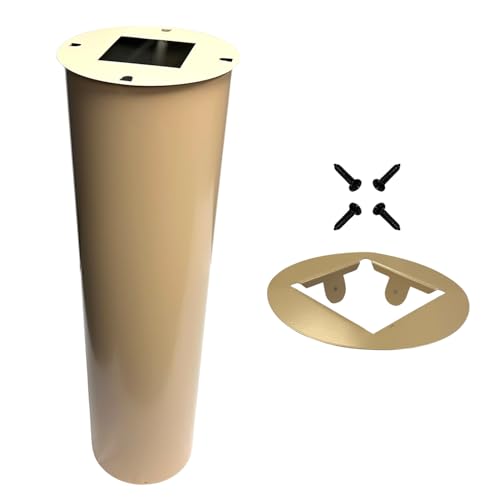 Erva SB3 Raccoon and Squirrel Baffle for 4x4 PostsThe one here that fits a square wooden post, which is what most home-built nest box mounts actually are. | Boxes on a wooden 4x4 | Check price on Amazon |
| 4 |  Erva FP5TLM4B 4-Arm Premium Feeder Pole SetA sectional made-in-USA pole on a twist-in ground socket, in tubing the maker states is nearly twice the industry-standard wall thickness. The system you extend rather than replace. | Buying once, and adding to it later | Check price on Amazon |
| 5 |  Woodlink BCBAF22 Wrap-Around Squirrel BaffleWraps around an installed pole and closes, so nothing has to come apart. That is the whole argument for it, and in January it is a very good argument. | A pole that is already in the ground | Check price on Amazon |
#ad how we are funded · no live price right now
The picks in full
Top pick Meeting the published raccoon specification
Songbird Essentials Predator Defeater Raccoon Baffle, 24" x 8"
A 24-inch cylinder, which is the length the raccoon guidance actually calls for — most baffles sold for squirrels are far shorter and a raccoon simply climbs past them.
Specifications
- Height
- 24"
- Diameter
- 8"
- Type
- Cylinder / stovepipe pole baffle
- Fits poles
- Adjusts to roughly 0.5" to 1.375" diameter
- Not for
- One-piece poles or shepherd's hooks, per the maker
- Maker's siting advice
- Mount at least 4.5 ft off the ground, pole at least 8 ft from any tree or launch point
- Material
- Powder-coated metal (one retailer lists plastic — see cons)
- Model
- SESQR87
Trade-offs
- 24 inches is the length the published raccoon guidance calls for, and most baffles sold are shorter
- A cylinder rather than a cone — a raccoon cannot get a grip above it the way it can on a shallow dome
- Adjusts across a usable range of pole diameters rather than fitting one size
- The maker publishes its own siting numbers, which most baffle sellers do not
- Explicitly not for one-piece poles or shepherd's hooks, which rules out a lot of existing setups
- Retailers disagree on the material — most say powder-coated metal, at least one says plastic, and nobody publishes a gauge
- There is no official manufacturer product page we could find, so every figure here comes from retailers
- A baffle this long needs a pole tall enough to carry it at 4.5 ft and still leave the feeder reachable
Who it is forSomeone losing a feeder overnight to raccoons who already runs a sectional pole with real clearance around it.
Skip it ifSkip it if your feeder hangs from a shepherd's hook or a branch. The maker says it does not fit a one-piece pole or hook, and on a hanging feeder a raccoon arrives from above where no pole baffle helps.
#ad how we are funded · no live price right now
Where these specs came from
No. 2 Stopping the climb before it starts
Woodlink Torpedo Raccoon and Squirrel Baffle, set of 2
The stovepipe shape, in a two-pack. A climbing animal cannot get past a cylinder that tips and spins, and this is the design that has worked for decades.
Specifications
- Type
- Stovepipe / torpedo pole baffle
- Pack
- 2
- Fits
- 1.5 in poles
- Targets
- Raccoons and squirrels
- Finish
- Black steel
Trade-offs
- Stovepipe baffles are the design that actually works against raccoons, not just squirrels
- Two in a pack covers a feeder pole and a box pole in one purchase
- Steel, so a squirrel cannot chew past it
- Protects a nest box far more effectively than anything you can add to the box itself
- Fits 1.5 in poles only — measure before ordering
- Needs about 4 to 5 ft of clear pole beneath it, or animals simply jump over it
- Useless if there is a fence, branch or wall within jumping distance
Who it is forPole-mounted nest boxes and feeders with clear space around them.
Skip it ifSkip it if your box is on a tree trunk. A pole baffle needs a pole; a trunk-mounted box needs a wrap-around guard or relocation.
#ad how we are funded · no live price right now
No. 3 Boxes on a wooden 4x4
Erva SB3 Raccoon and Squirrel Baffle for 4x4 Posts
The one here that fits a square wooden post, which is what most home-built nest box mounts actually are.
Specifications
- Fits
- 4 x 4 in wooden posts
- Type
- Slide-over stovepipe baffle
- Targets
- Raccoons and squirrels
- Color
- Tan
Trade-offs
- Fits square wooden posts, which almost no round-pole baffle does
- Stovepipe geometry, so it works on raccoons rather than only squirrels
- Slides over an existing post without rebuilding the mount
- Erva build quality and a made-in-USA finish
- 4x4 only — useless on a round pole or a 2x4
- A wooden post gives climbing grip right up to the baffle, unlike smooth steel
- More expensive than a generic round baffle
Who it is forNest and roost boxes mounted on 4x4 wooden posts.
Skip it ifSkip it if your box is on a round metal pole — the torpedo baffle is the right part, and it is cheaper.
#ad how we are funded · no live price right now
No. 4 Buying once, and adding to it later
Erva FP5TLM4B 4-Arm Premium Feeder Pole Set
A sectional made-in-USA pole on a twist-in ground socket, in tubing the maker states is nearly twice the industry-standard wall thickness. The system you extend rather than replace.
Specifications
- Pole height
- 80 in (98 in overall in-ground height)
- Pole diameter
- 1 in
- Construction
- 6-piece sectional
- Arms
- 4, forged twist
- Anchor
- Twist-in ground socket
- Origin
- Made in USA
Trade-offs
- Wall thickness is the spec Erva competes on, and it is the one that decides whether a pole bows under a snow-loaded feeder
- A twist-in socket means the pole lifts out of the socket — you can bring it in, move it, or swap the top without re-digging
- 1-inch diameter is the size most aftermarket baffles are built for, so you are not locked to one accessory
- Sectional, so you can extend it or change the arm top rather than buying a second pole
- Made in USA, and Erva is the one maker in this category that publishes real numbers
- No baffle included — budget for one separately, and it is not optional if you have squirrels
- 1 inch is the narrowest pole here; fine for four feeders, less happy carrying eight
- A sectional pole has joints, and joints are where a pole develops a lean over a wet winter
- Assembly is more involved than a one-piece hook
Who it is forSomeone building a station deliberately who wants a pole that accepts standard baffles and can be extended.
Skip it ifSkip it if you want one box that solves squirrels today. This is a pole, not a system — the baffle is a second purchase and a second decision.
#ad how we are funded · no live price right now
No. 5 A pole that is already in the ground
Woodlink BCBAF22 Wrap-Around Squirrel Baffle
Wraps around an installed pole and closes, so nothing has to come apart. That is the whole argument for it, and in January it is a very good argument.
Specifications
- Type
- Wrap-around baffle
- Model
- BCBAF22
- Material
- Steel
Trade-offs
- Fits without lifting the feeder, the pole or anything else out of frozen ground
- Steel rather than the thin aluminum most budget baffles use
- Woodlink build quality, and the finish survives a wet winter
- The retrofit answer, which is the situation most people are actually in
- Costs several times what a generic cone baffle costs
- A wrap-around seam is a weakness a determined squirrel can work at
- Still needs the clearance rule — ten feet from anything jumpable, or it does nothing
- Heavier than a cone, so a light pole may need re-seating afterwards
Who it is forRetrofitting a baffle to a station you already built and do not want to dismantle.
Skip it ifSkip it if the pole is not yet in the ground. A one-piece torpedo baffle threaded on first is cheaper and has no seam.
#ad how we are funded · no live price right now
First, is it actually a raccoon?
The damage pattern tells you, and it matters because the fix is different. Why birds are not coming to your feeder runs the full diagnosis; this is the short version for the overnight cases.
- Raccoons: the feeder is emptied overnight and is often damaged, opened or taken down entirely. Lids are pulled off, hooks bent, whole feeders found on the ground or carried off.
- Squirrels: daytime, feeder swinging, seed scattered, and the damage is chewing — gnawed ports and plastic rather than a feeder pulled apart.
- Deer: overnight, feeder emptied or knocked, pole bent, and hoof prints. No climbing involved and no baffle helps.
- Mice and rats: working the spill underneath rather than the feeder itself, which is a seed catcher problem.
If the feeder is intact but empty each morning, you may simply have a busy yard. If it is broken or missing, that is a raccoon.
Why your squirrel hardware does not transfer
This site's squirrel advice is good advice and it does not carry over. Two reasons, and both are about the animal rather than the product.
A raccoon is far bigger and has hands. Audubon's guidance makes the distinction plainly: raccoons cannot jump as well as squirrels, but they are great climbers and need their own guard on the pole. Reach and strength are the difference — a raccoon standing at the base of a baffle can get its arms over a short one, and one that reaches the feeder can simply pull it apart.
Weight mechanisms are built around a perch. A weight-activated feeder closes when something heavy stands on the perch ring, which is exactly what a squirrel does. The published raccoon guidance from Project FeederWatch, the Humane Society and Audubon is not about feeder mechanisms at all — it is about making the feeder physically inaccessible, with baffles, fencing or suspension. That tells you where to spend.
The numbers, and who publishes them
Sources give different figures and we are printing them as each one states them rather than averaging them into a single invented number.
| Source | Guard | Height | Clearance |
|---|---|---|---|
| Humane Society | Stovepipe at least 24 in long | At least 4 ft off the ground | Not stated |
| Songbird Essentials (maker) | 24 in cylinder | At least 4.5 ft | At least 8 ft from any tree or launch point |
| Audubon | A guard on the pole; raccoons climb well but jump poorly | Not stated | At least 10 ft from the nearest shrub, tree or tall structure |
| Penn State Extension (nest boxes) | 2 ft wide metal collar | 3 ft off the ground | Not stated |
| Project FeederWatch | Baffles or fencing; or suspend from a cable between two trees | Above reach | Not stated |
The clearance figures disagree — 8 ft from the maker, 10 ft from Audubon — and the height figures sit between 4 and 4.5 ft. Take the larger number of any pair if your yard allows it; the cost of over-doing clearance is nothing, and the cost of under-doing it is the whole feeder.
The 24-inch figure is the one that changes what you buy. Walk through the baffles sold for squirrels and a lot of them are cones or cylinders well under that — the common cheap pole baffles run around 19 inches. Against a squirrel that is enough. Against a raccoon, the published advice says it is not.
The free fix, which is also the best one
Raccoons are nocturnal. Project FeederWatch's guidance says plainly that taking feeders in at night helps when the visits happen only after dark — and for most yards, that is the whole problem.
This costs nothing, needs no hardware, and has no failure mode. It also costs the birds nothing: they feed in daylight, so a feeder that goes out at dawn and comes in at dusk serves every bird that was going to use it. The only real objection is that it is a daily chore in bad weather — which is the same objection that makes capacity the winter specification on every feeder page here.
If you are going to buy hardware anyway, do this as well for the first week. It tells you whether raccoons were the problem, before you have spent anything.
Where the hardware route actually works
A pole baffle works on a pole, and only when the pole is genuinely out of reach of everything else. That is the condition most yards fail — the picture at the top of this page is a raccoon on a fence, which is a launch point, and no baffle below it is relevant.
So the order is the same as it is for squirrels, and the baffle-or-mechanism comparison prices it: placement first, then the pole, then the baffle. The pole page covers the anchoring, and it matters more here because a raccoon will lean on what it climbs.
A hanging feeder is the hard case. A raccoon comes down the branch from above, where a pole baffle has nothing to interrupt. Project FeederWatch's suggestion for that situation is to suspend feeders from a cable strung between two trees, high enough and far enough from either trunk — which is a rigging job rather than a product.
What not to do
One piece of folk advice turns up constantly and should not be followed: do not grease the pole or the wire. Project FeederWatch and Audubon both warn against it for the same reason — grease gets onto birds' feathers and they cannot preen it out. A bird that cannot keep its plumage in order in winter has lost its insulation, which in this season is not a cosmetic problem.
The same goes for anything sticky, oily or chemical applied to a pole. If a deterrent would be a problem on feathers, it is a problem.
The part that has nothing to do with feeders
A raccoon that finds food in your yard will keep checking your yard. If there is pet food on a porch, an open compost heap or a bin that does not latch, the feeder is one stop on a round that is worth making. Removing the rest of the food is the step that decides whether your baffle is solving a problem or just moving it.
And whatever is under the feeder matters too — spilled seed is a food source in its own right, which is the argument for a catcher or hulled seed if the ground beneath your station is covered.
What we would skip
What we would skip
Greasing the pole or the wire
Project FeederWatch and Audubon both warn against it: the grease transfers to birds' feathers and they cannot preen it out. In winter, plumage is insulation. This one is a welfare problem, not a preference.
A short squirrel baffle, used against raccoons
The published guidance calls for a stovepipe of at least 24 inches, and the common cheap pole baffles are around 19. Against a squirrel that is fine; a raccoon has the reach to get above a short one.
A pole baffle under a feeder hanging from a branch
A raccoon comes down the branch from above, so there is no climb for a pole baffle to interrupt. Project FeederWatch's answer for hanging feeders is a cable strung between two trees instead.
Buying hardware before trying the free fix
Raccoons feed after dark. Bringing feeders in at dusk for a week costs nothing, serves the birds exactly as well, and tells you whether raccoons were the problem before you spend anything.
Fixing the feeder and leaving the rest of the buffet
Pet food on a porch, an open compost heap or an unlatched bin keeps a raccoon coming back to the yard. The baffle then protects one item on a round it is still making.
How we judged this
How we picked
- Published guidance from named sources only — Project FeederWatch, the Humane Society, Audubon and Penn State Extension — because this topic's search results are dominated by content farms repeating each other.
- Figures printed as each source states them, including where they disagree: 8 ft of clearance from the maker against 10 ft from Audubon, and 4 ft against 4.5 ft of height.
- Baffle length treated as the deciding specification, since it is the one that separates raccoon hardware from squirrel hardware.
- The free, no-hardware option given first, because raccoons are nocturnal and it genuinely works.
- Welfare checked before recommending any deterrent — greasing a pole is widely suggested online and is explicitly warned against by two of the sources here.
- Current availability, checked against the Amazon catalog before publishing.
- Live price, refreshed daily and never typed into this page by hand.
We have not tested any of these. What we did instead: read the manufacturers’ own listings, compiled the published specifications, computed the running cost at a cited electricity rate, and refreshed the prices daily. The full method is published.
Questions people actually ask
- Will a squirrel baffle stop a raccoon?
- Usually not, if it is a standard short one. The Humane Society's guidance calls for a stovepipe at least 24 inches long mounted at least 4 feet up, and many baffles sold for squirrels are around 19 inches. A raccoon has the reach to get above a short baffle.
- Will a squirrel-proof feeder keep raccoons out?
- It is not what stops them. A weight mechanism is built around something standing on a perch; the published raccoon guidance is about making the feeder physically inaccessible with baffles, fencing or suspension. Spend on access, not on the mechanism.
- How high should a raccoon baffle be?
- Sources give 4 ft (Humane Society) to 4.5 ft (the baffle maker's own advice). Take the higher figure if your pole allows it while still leaving the feeder reachable for refilling.
- How far should a feeder be from trees and fences to stop raccoons?
- Published figures differ — at least 8 ft per the baffle maker, at least 10 ft per Audubon. Raccoons climb well, so anything climbable within that radius is a launch point and the baffle below it becomes irrelevant.
- Does bringing bird feeders in at night work?
- Yes, and it is the simplest answer. Raccoons feed after dark, so a feeder indoors at dusk is unreachable. Project FeederWatch notes it helps where visits happen only at night, and birds lose nothing because they feed in daylight.
- Should I grease the pole to stop raccoons?
- No. Project FeederWatch and Audubon both warn against it because grease transfers to birds' feathers and they cannot preen it out. In winter that costs a bird its insulation.
Sources
- Project FeederWatch (Cornell Lab of Ornithology) — Deterring unwanted visitors: baffles and fencing for raccoons, suspending feeders from a cable between two trees, taking feeders in at night, and the warning against greasing poles
- The Humane Society of the United States — What to do about raccoons: stovepipe-style guard at least 24 inches long, mounted at least 4 feet off the ground
- Audubon — How to stop squirrels raiding your bird feeders: raccoons climb well but jump poorly and need their own pole guard; feeders at least 10 feet from the nearest shrub, tree or tall structure
- Penn State Extension — Managing habitat for eastern bluebirds: a 2-foot-wide metal collar 3 feet off the ground keeps raccoons off nest-box poles
Read next
- The Best Squirrel Baffles for Feeder Poles
Stovepipe, wrap-around, post and hanging-dome baffles ranked by what they mount to, plus the height and clearance numbers that decide whether one works.
- Baffle or Squirrel-Proof Feeder?
Baffle plus pole, or a weight-activated feeder? Both routes costed honestly, including the pole the baffle advice never mentions.
- The Best Bird Feeder Poles for Winter
Auger, prong or clamp — the anchor is the spec that decides whether a pole survives winter. Seven mounts ranked, plus the diameter question that decides which baffles fit.
- Why Birds Are Not Coming to Your Feeder
Eight causes ranked by how often they are actually the problem, the two-week rule for testing any change, and the six fixes worth buying.
- Predator Guards for Nest and Roost Boxes
Stovepipe pole baffles and entrance portal guards, ranked — plus the clearance rule that decides whether any of them work.