Winter feeders / Data
What Color Bird Feeder Do Birds Prefer?
There is exactly one published study that measured this, its answer is the opposite of what the garden-center shelf suggests, and its own authors are careful about how far it goes.
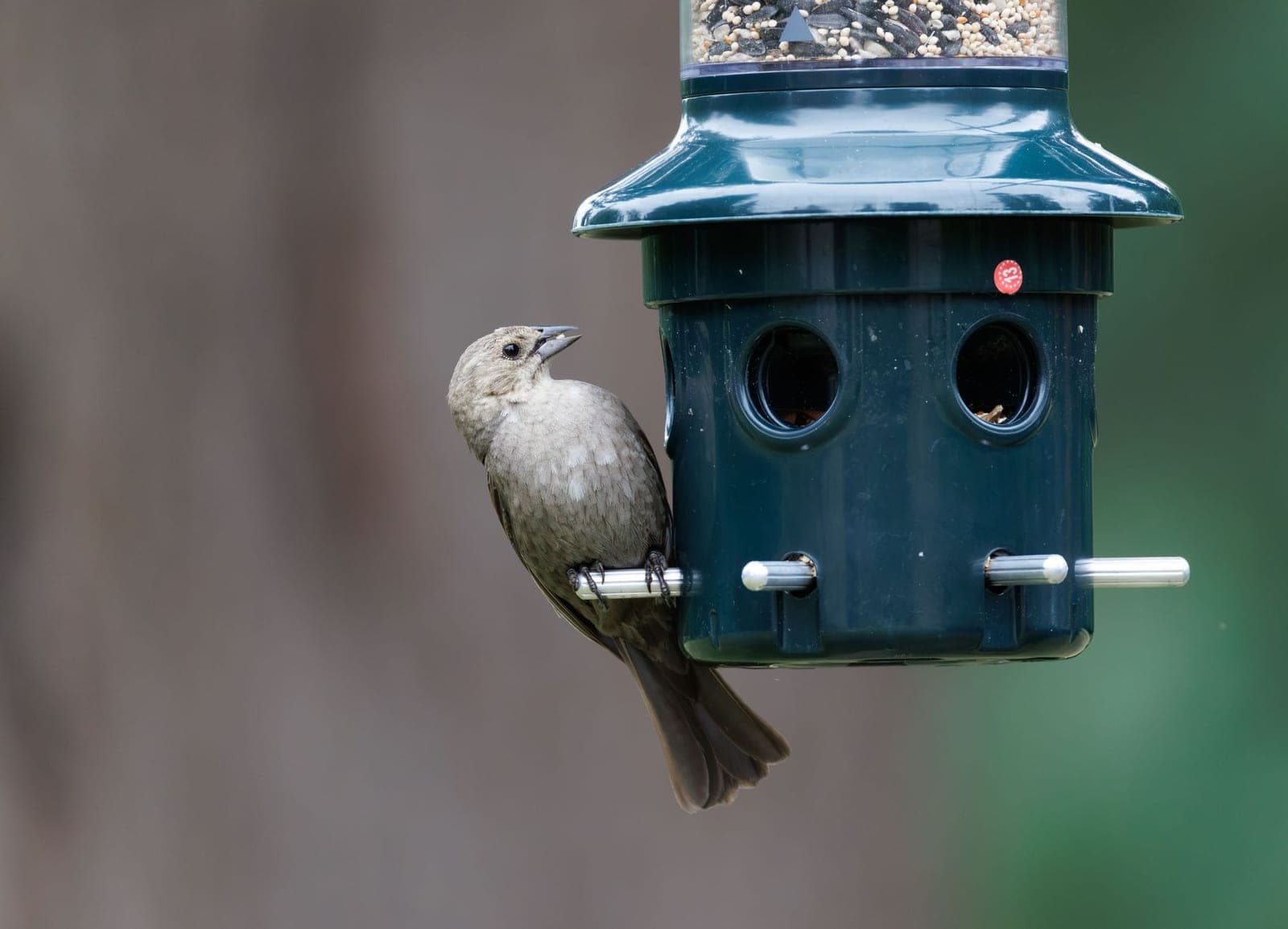
Silver and green feeders got the most visits, and red and yellow the fewest, in the one peer-reviewed study that measured it — 7,535 feeding visits across 370 half-hour watches at eight differently colored feeders. But the same authors note that cover distance and food type matter more than color, and the study was done on British garden birds with all eight colors hanging side by side. So: treat color as a tiebreaker, not a criterion. Buy the feeder with the right capacity and drainage, and if two are equal, take the neutral or metallic finish over the bright red one.
Winter Perch is funded by affiliate commission. If you buy through a link on this page we may earn a commission at no extra cost to you, and it never decides a ranking. Full disclosure · how we pick.
Quick picks
Ranked, with the trade-off named. Tap a row for the full write-up; the price button goes straight to Amazon.
| # | Product | Best for | Price |
|---|---|---|---|
| 1 |  Kingsyard 15" Metal Tube Feeder, 6 PortsAn all-metal body and ports for under twenty dollars, with one real catch: the perch is sized for small birds and is meant to turn larger ones away. | Metal ports at a plastic-tube price | Check price on Amazon |
| 2 |  Woodlink NACOP Audubon Copper Tube Feeder with Tray, 16.5"The tray at the base is the reason to buy this one: it catches the seed the ports throw and gives the ground feeders somewhere to stand while they eat it. | A tube that catches its own spill | Check price on Amazon |
| 3 |  Nature's Way CWF2 Cedar Upside-Down Suet FeederThe cake faces down, so a bird has to hang underneath to eat. Woodpeckers, nuthatches and chickadees do that happily. Starlings largely will not. | Starling exclusion without a mechanism | Check price on Amazon |
| 4 | 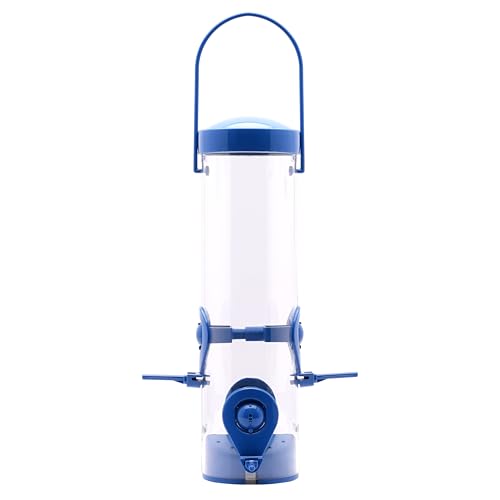 Perky-Pet Navy 2-in-1 Tube Bird FeederPerky-Pet is a long-standing brand and this is about as little as you can spend on one of their feeders. Four ports, basic plastic, and no pretension — which at this price is the correct set of expectations. | The cheapest feeder here that is not a gamble | Check price on Amazon |
| 5 |  Droll Yankees Yankee Tipper, 17 in, 4 portsInstead of closing a shroud, the perch tips under weight and the squirrel slides off. A different mechanism, and the one to try when a weight-activated shroud has been defeated. | Squirrels that have beaten a shroud feeder | Check price on Amazon |
#ad how we are funded · no live price right now
The picks in full
Top pick Metal ports at a plastic-tube price
Kingsyard 15" Metal Tube Feeder, 6 Ports
An all-metal body and ports for under twenty dollars, with one real catch: the perch is sized for small birds and is meant to turn larger ones away.
Specifications
- Seed capacity
- Up to 2 lb
- Feeding ports
- 6
- Height
- 15"
- Material
- Metal, anti-rust powder-coated finish
- Ports, lid and base
- Metal, stated chew-resistant
- Perch
- 1.7", stated to suit finches and chickadees and to discourage larger birds
- Seed
- Stated to suit sunflower, safflower, milo, millet, thistle and peanuts
Trade-offs
- Metal ports, lid and base at a price where everything else is plastic
- Six ports and 2 lb is a genuinely usable winter combination
- Powder-coated rather than bare steel, which is what rusts at the ports first
- Takes thistle as well as sunflower, so it covers the finch case without a second feeder
- The 1.7 inch perch is deliberately short — cardinals, jays and grosbeaks are designed out, not accommodated
- No roof or weather guard, and no drainage detail is published
- Kingsyard is an Amazon-native brand with no warranty figure we could find
- Metal conducts, so the ports ice up as readily as anything else here
Who it is forSomeone feeding chickadees, finches and nuthatches who wants the squirrel-chewing problem solved at the port without paying for a mechanism.
Skip it ifSkip it if cardinals are the point of your feeder. The short perch is the design, not a flaw, and no cardinal is going to use it comfortably.
#ad how we are funded · no live price right now
No. 2 A tube that catches its own spill
Woodlink NACOP Audubon Copper Tube Feeder with Tray, 16.5"
The tray at the base is the reason to buy this one: it catches the seed the ports throw and gives the ground feeders somewhere to stand while they eat it.
Specifications
- Seed capacity
- Up to 1.5 lb, thistle or mixed seed
- Feeding ports
- 2
- Dimensions
- 7.75" x 7.75" x 16.5"
- Material
- Copper with easy-refill top
- Included
- Catch tray
- Weight
- 1.2 lb
- Mount
- Hanging
Trade-offs
- The built-in tray does the job of a separate seed catcher, which is normally another purchase
- The tray doubles as a standing surface, so cardinals and juncos can use a feeder they otherwise could not
- Copper weathers to a finish that looks deliberate rather than tired
- Easy-refill top, so there is no fiddling with a cap in gloves
- Two ports on a 16.5 inch feeder is a poor ratio, and the queue forms fast
- The tray collects snow and wet seed, so it is one more thing to brush out after a fall
- 1.5 lb is middling capacity for the money
- Copper is a finish here, not a structural upgrade — the ports are still the weak point
Who it is forSomeone running a feeder over a deck, a path or a lawn they care about, who wants the spill contained without bolting on a second accessory.
Skip it ifSkip it if your feeder hangs over rough ground or a border, where spill is not a problem worth paying for. A plain tube and a tolerance for scattered seed costs half as much.
#ad how we are funded · no live price right now
No. 3 Starling exclusion without a mechanism
Nature's Way CWF2 Cedar Upside-Down Suet Feeder
The cake faces down, so a bird has to hang underneath to eat. Woodpeckers, nuthatches and chickadees do that happily. Starlings largely will not.
Specifications
- Capacity
- 1 standard cake
- Orientation
- Downward-facing cake
- Material
- Cedar with roof
- Mechanism
- None — geometry only
Trade-offs
- Excludes most starlings through geometry, with nothing to break or freeze
- The roof keeps snow and rain off the cake
- Cedar body, weathers well
- Clinging birds are the ones you wanted anyway
- It is not perfect — determined starlings learn to hang
- Loading a cake face-down is fiddlier than a front-opening cage
- One cake
Who it is forAnyone whose plain cage feeder has been taken over by starlings or grackles.
Skip it ifSkip it if your main visitors are cardinals and jays, which will not hang upside down. You will have excluded the birds you were feeding.
#ad how we are funded · no live price right now
Where these specs came from
No. 4 The cheapest feeder here that is not a gamble
Perky-Pet Navy 2-in-1 Tube Bird Feeder
Perky-Pet is a long-standing brand and this is about as little as you can spend on one of their feeders. Four ports, basic plastic, and no pretension — which at this price is the correct set of expectations.
Specifications
- Ports
- 4
- Type
- Tube
Trade-offs
- A recognized brand at a genuinely low price, rather than an anonymous listing
- Four ports is enough for a small yard
- Simple tube construction means almost nothing to break
- Small capacity, so in a cold snap you are refilling every day or two
- Thin plastic that squirrels chew through quickly
- No seed tray, so spill goes straight to the ground
- Basic ports clog with damp seed and are awkward to clean thoroughly
Who it is forA first feeder, or a spare to run alongside a better one.
Skip it ifSkip it where squirrels are active. Cheap plastic is squirrel food, and you will be buying twice.
#ad how we are funded · no live price right now
No. 5 Squirrels that have beaten a shroud feeder
Droll Yankees Yankee Tipper, 17 in, 4 ports
Instead of closing a shroud, the perch tips under weight and the squirrel slides off. A different mechanism, and the one to try when a weight-activated shroud has been defeated.
Specifications
- Mechanism
- Weight-activated tipping perch
- Length
- 17 in
- Ports
- 4
Trade-offs
- A tipping perch cannot be held open the way a shroud sometimes can be
- Droll Yankees build quality is genuinely a step above the mass-market feeders
- Four ports on a 17-inch body is generous spacing, so birds are not queuing
- Backed by a long manufacturer warranty
- Among the most expensive feeders on this site
- The tipping action can unsettle nervous birds at first
- Moving parts in freezing rain need checking; ice on the pivot stops it working
- No cardinal ring, so the biggest perching birds are awkward on it
Who it is forSomeone who has already bought a cheaper squirrel-proof feeder and watched it fail.
Skip it ifSkip it if this is your first attempt. Start with a shroud feeder, which costs less and works for most yards.
#ad how we are funded · no live price right now
How we judged this
How we picked
- One peer-reviewed study, read directly — Rothery, Scott and Morrell (2017), rather than a secondary retelling of it. The design, sample and limitations below are the paper's own.
- Limitations stated as prominently as the result, because a single study on non-American species with all colors presented together is weak evidence and presenting it as settled would be dishonest.
- No extrapolation to bird baths or to species the study did not include. Where no evidence exists, this page says there is none.
- Color ranked against the specifications that are known to matter — capacity, drainage, siting and food — rather than treated as an independent decision.
- Picks chosen on feeder quality first, with finish used only to break ties. Each product's finish is taken from the manufacturer's own listing.
- Every pick confirmed currently purchasable against the Amazon catalog on the day of writing, with live prices from the daily refresh.
We have not tested any of these. What we did instead: read the manufacturers’ own listings, compiled the published specifications, computed the running cost at a cited electricity rate, and refreshed the prices daily. The full method is published.
The one study that actually measured it
Rothery, Scott and Morrell published it in PLoS ONE in February 2017, and the design is simple enough to describe in a paragraph.
Eight transparent tube feeders with painted metal parts, in black, blue, dark green, purple, red, silver and white, plus yellow, hung in a line with the same seed blend in all of them. Positions were re-randomized after every watch, to stop a feeder's place in the line being mistaken for its color. The observers logged 370 half-hour observation periods over 78 sampling days, from November 2014 to May 2015, at three sites: a nature reserve, a university botanic garden and a suburban garden. Total: 7,535 feeding visits.
| Result | Finding |
|---|---|
| Most visited overall | Silver |
| Next | Dark green — more visited than any color except silver |
| Least visited overall | Red and yellow |
| No difference between | Blue, purple, white and black |
| Species with significant effects | Blue tit, great tit, coal tit, house sparrow, robin |
| Species with no color effect | Greenfinch, starling |
| Blue tits specifically | Yellow and red least visited |
| House sparrows specifically | Yellow least visited; blue, green and black most |
| Robins specifically | Black most visited; purple and white least |
The paper reports visit counts in its figures and tables rather than in the text, so the ranking above is the published ordering rather than a set of totals we can quote. The authors' own conclusion is one line: they suggest green feeders may be "simultaneously marketable and attractive to foraging birds".
People buy the colors the birds visited least
The same researchers ran a human preference survey alongside it — 587 votes, at a garden center and a science festival. People preferred red, yellow, green and blue. Silver was rarely chosen.
Put the two results together and you get the finding worth remembering: the two colors people liked most were the two the birds visited least. That is a straightforward explanation for why the shelf looks the way it does. Feeders are sold to humans standing in a shop, and red sells.
What the study does not prove
This is where most retellings of this research go wrong, so it is worth being exact. The authors list the limitations themselves, and they are substantial.
- It is a British study on British species. Blue tits, great tits, coal tits, house sparrows and robins are not the birds at an American winter feeder. Chickadees, titmice, nuthatches, juncos and cardinals were not in it.
- All eight colors hung together. The authors say plainly that presenting the colors side by side could bias the choices, and that the study cannot tell you whether color would matter at all to a feeder used on its own — which is how yours will be used.
- Familiarity may be doing the work. Silver and green are common feeder colors in the UK, and the birds were at regularly fed sites. Preferring the familiar object is not the same as preferring the color.
- The colors were chosen for human eyes. Birds are tetrachromatic and see into the ultraviolet, so they did not perceive these eight paints the way the researchers did, and the paints were picked for availability.
- Competition muddied the counts. Birds displaced each other between feeders, which the authors note may mask a genuine preference, because a displaced bird gets recorded at a feeder it did not choose.
- The authors rank color below other factors. Their own framing is that things like cover distance and food type may matter more to a feeder's success.
A later study in Poland followed up on the familiarity question specifically, testing yellow against green with urban and rural birds to see whether prior exposure changes how wary birds are of an unfamiliar object. That is the live scientific question here: not "what color do birds like" but "how quickly do birds accept a new object in their territory".
Red, and the hummingbird exception
Red is the one color with a genuine basis in bird behavior, and it is not about seed feeders.
Hummingbirds are drawn to red because they feed at flowers, and nectar feeders are made red for that reason. That logic does not transfer to a seed tube — nothing at a winter seed feeder is looking for a flower. And the hummingbird case comes with its own hard rule: the feeder can be red, the nectar must not be. Never add red dye to sugar water. Heated hummingbird feeders covers the winter end of that, which is a narrow problem affecting a few western and southern yards.
What matters more than color in winter
Four things, each of which outranks the paint on the metalwork. If you are choosing a feeder and worrying about color, you are worrying about the last item on the list.
- Capacity. The spec that decides whether you are still refilling in February, in sleet, in the dark. The winter feeder roundup ranks on it first for exactly that reason.
- Drainage and ventilation. A feeder that holds water grows mold, and moldy seed is actively harmful rather than merely wasted.
- Where it hangs. About ten feet from dense cover — close enough for an escape route from a hawk, far enough that a cat cannot launch from it. Placement in snow and wind is free and does more than any purchase.
- What is in it. Straight black oil sunflower reaches more species than any paint job ever will. The seed roundup ranks on usable fat per pound.
So which finish should you actually buy?
Given weak evidence, the sensible approach is to let color break a tie between feeders that are already right on capacity and drainage — and in winter there is one extra consideration the study had nothing to say about.
- A clear or transparent tube is worth more than any color, because you can see the seed level from the window. In a season when going outside is the chore, knowing whether a trip is necessary is a real feature.
- Metallic and dark green finishes are on the right side of the evidence, such as it is, and they are also the finishes that hide weathering. A copper or brushed-metal top ages better than painted plastic in freeze-thaw.
- Black is neutral in the data — robins actually visited it most — and it is the most common finish on well-made feeders, so you are not giving anything up.
- Bright red and yellow are the only finishes the evidence argues against. Not strongly, and not for American species, but if you have a choice and no other reason, choose otherwise.
- Metal over thin plastic matters more than the color of either. Acrylic goes brittle in deep cold; polycarbonate and metal survive the season.
What about bird bath color?
The same question gets asked about baths and there is no equivalent study — the 2017 work was about seed feeders. Anyone telling you birds prefer a particular color of bath is extrapolating, and we are not going to.
What does have evidence behind it for baths is depth, movement and the material. An inch at the edge and no more than two in the middle is the spec that decides whether small birds use a bath at all, and it outweighs anything color could do. On a heated bath, the material matters for a harder reason: concrete and unglazed ceramic spall in a freeze regardless of how good they look.
What we would skip
What we would skip
Choosing a feeder on color at all, if the specs are wrong
A 1 lb red tube and a 1 lb silver tube are the same mistake in different paint. Capacity, drainage and a base that comes off for cleaning decide whether a feeder survives a winter of use.
Repainting a feeder to "improve" it
The evidence is far too weak to justify putting paint near something birds eat from, and the solvents and finishes are a genuine risk. If the color bothers you, buy a different feeder.
Red dye in nectar, for the one feeder where red is relevant
The feeder may be red; the sugar water must not be. There is no reason to add dye and no shortage of reasons not to.
Bright white feeders, on a thin rationale
White was mid-table in the study and nobody has shown it matters. It does show every mark, and in a season of mud, hulls and droppings that is a cosmetic problem rather than a bird one.
Any conclusion about American feeder birds from this study
It measured blue tits, great tits, coal tits, house sparrows and robins in Britain. Applying the ranking to a chickadee or a cardinal is a guess, and this page would rather say so than dress it up.
Questions people actually ask
- What color bird feeder attracts the most birds?
- In the only published study that measured it, silver drew the most visits and dark green was second, while red and yellow drew the fewest. It was a British study on British garden birds, with all eight colors hung side by side, so treat it as a tiebreaker rather than a rule.
- Do birds avoid red feeders?
- Red was among the least-visited colors in that study, but "least visited of eight" is not "avoided". Hummingbirds are the exception that proves the rule — they are drawn to red because they feed at flowers, which has nothing to do with a seed tube.
- Does feeder color matter more than where I hang it?
- No, and the study's own authors say so: cover distance and food type matter more than color. About ten feet from dense cover is the siting rule, and it costs nothing.
- What color bird bath do birds prefer?
- Nobody knows, because the research was about seed feeders and no equivalent study exists for baths. What is known about baths is that depth decides whether small birds use them — an inch at the edge, no more than two in the middle.
- Should I buy a clear feeder?
- If the choice is between a clear tube and an opaque one of the same quality, yes — not for the birds but for you. Seeing the seed level from indoors is what stops a wasted trip out in bad weather.
- Birds are not using my new feeder. Is it the color?
- Almost certainly not. Birds take days to accept any new object, and the usual causes are stale seed, the wrong seed, no cover nearby or a feeder that nothing can perch on. The full checklist.
Sources
- Rothery L, Scott GW, Morrell LJ (2017) "Colour preferences of UK garden birds at supplementary seed feeders." PLoS ONE 12(2): e0172422 — eight feeder colors, 370 thirty-minute observation periods over 78 days, 7,535 visits; silver most visited, green second, red and yellow least; 587-vote human preference survey; authors' stated limitations
- Journal of Ornithology (2021) — follow-up work on whether prior exposure to feeder colors affects how wary birds are of novel objects, in urban and rural populations
Read next
- The Best Bird Feeders for Winter
Seed feeders ranked on capacity, roofing and drainage — the specs that decide how often you go out in bad weather.
- The Best Tube Bird Feeders for Winter
Capacity, a base that comes off without tools, metal ports and somewhere for water to go — the four specs that decide a winter tube, with five picks ranked on them.
- Feeder Placement in Snow and Wind
Wind shelter, drift lines, roof drip and height above snow — where to hang a feeder so the weather does not close it.
- Why Birds Are Not Coming to Your Feeder
Eight causes ranked by how often they are actually the problem, the two-week rule for testing any change, and the six fixes worth buying.
- The Best Bird Seed for Winter
Five winter seeds ranked on usable fat, shell thickness and species reach — plus the cheap mix that is worth avoiding.