Winter feeders / Roundup
The Best Hopper Bird Feeders for Winter
The house-shaped feeder does two things a tube cannot: it puts a roof over the seed and it gives a heavy bird a ledge to stand on. It also fails in one specific way, and the fix is a specification you can check before buying.
A hopper feeder is a roofed box that drops seed onto an open tray. Buy on drainage first — a mesh or screened floor, not a solid one — then capacity, then roof overhang. The Woodlink Absolute II holds 12 lb behind a weight-activated shield; the Birds Choice has the best drainage for half the money.
Winter Perch is funded by affiliate commission. If you buy through a link on this page we may earn a commission at no extra cost to you, and it never decides a ranking. Full disclosure · how we pick.
Quick picks
Ranked, with the trade-off named. Tap a row for the full write-up; the price button goes straight to Amazon.
| # | Product | Best for | Price |
|---|---|---|---|
| 1 | 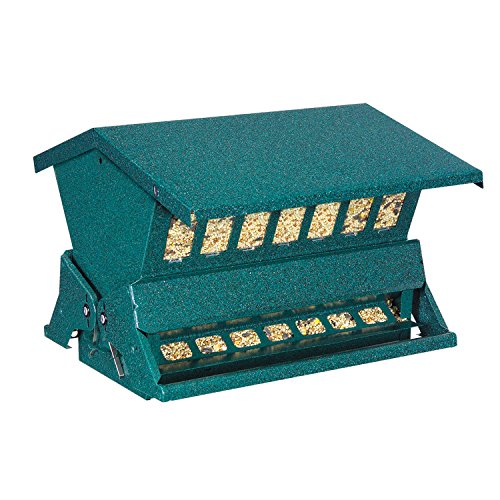 Woodlink Absolute II Squirrel-Resistant Feeder, 12 lbTwelve pounds of seed behind a weight-activated steel shield — the only feeder here you can fill before a storm and forget about until it clears. | The longest refill interval on the page | $84.00 · See it on Amazon |
| 2 |  Birds Choice Medium Hopper Feeder, 3 lb, Recycled PolyA patented mesh screen floor instead of a solid one, which is the difference between a hopper and a box that holds wet seed all winter. | Drainage, which is the spec most hoppers get wrong | $44.99 · See it on Amazon |
| 3 |  DutchCrafters Poly Large Hanging Hopper FeederAmish-built from recycled HDPE with an aluminum mesh floor and a roof that overhangs the tray — the construction here is the argument, not the capacity. | Outlasting the weather rather than surviving it | $89.00 · See it on Amazon |
| 4 |  Solution4Patio Cedar Hopper Feeder with Double Suet CagesSeed in the middle, a suet cage on each end — one trip outside instead of two, which is the whole point in a blizzard. | Running seed and suet off one hook | $36.99 · See it on Amazon |
| 5 |  Kingsyard Feeder House, 4 lb, Recycled PlasticFour pounds and drainage holes for the price of a bag of sunflower — the honest budget answer, with the build quality you would expect at the price. | Four pounds of capacity at the bottom of the market | $23.74 · See it on Amazon |
#ad how we are funded · price as of October 10, 2026
The picks in full
Top pick The longest refill interval on the page
Woodlink Absolute II Squirrel-Resistant Feeder, 12 lb
Twelve pounds of seed behind a weight-activated steel shield — the only feeder here you can fill before a storm and forget about until it clears.
Specifications
- Seed capacity
- 12 lb
- Dimensions
- 16"W x 11.25"H x 13.5"D
- Material
- Steel
- Mechanism
- Spring-activated perches; a metal shield covers the seed tray under weight
- Perches
- Two counterbalance perches, adjustable to three positions
- Top
- Locking
- Included
- Steel hanging rod; 5 ft sectional pole kit with mounting bracket
- Warranty
- 1 year limited
Trade-offs
- 12 lb is far and away the largest capacity on this page, and capacity is the winter specification
- The counterbalance perches adjust across three settings, so you choose the weight at which the shield closes
- Steel body and a locking top — nothing here for a squirrel to chew through or lift off
- Ships fully assembled with both a hanging rod and a pole kit, so no second purchase to mount it
- Takes mixed seed, sunflower, safflower and peanut halves rather than one narrow seed type
- The most expensive feeder on this page by a wide margin
- The shield is a moving mechanism outdoors all winter, and seed dust and freezing rain are what it has to keep working through
- A 1-year limited warranty is short next to the lifetime cover on some simpler feeders
- Set the perches too light and you exclude cardinals and jays along with the squirrels
- Woodlink publishes no drainage or ventilation detail for the seed tray
Who it is forSomeone running a feeder they cannot top up daily — a second property, a long driveway, or simply a yard where February refills are the thing that defeats them.
Skip it ifSkip it if your yard has no squirrel problem. You are paying mostly for the mechanism, and a plain hopper with a good drainage screen feeds the same birds for a third of the money.
#ad how we are funded · price as of October 10, 2026
Where these specs came from
- Woodlink Absolute II Squirrel Resistant Bird Feeder Model 7536, 12 lb — manufacturer listing, Amazon.com (retrieved 2026-10-10)
- Tractor Supply — Woodlink 12 lb Absolute II Squirrel-Resistant Bird Feeder: 12 lb capacity, 16" x 11.25" x 13.5", steel, locking top, spring-activated perches, two counterbalance perches with three positions, 1-year limited warranty, hanging rod and 5 ft pole kit included
No. 2 Drainage, which is the spec most hoppers get wrong
Birds Choice Medium Hopper Feeder, 3 lb, Recycled Poly
A patented mesh screen floor instead of a solid one, which is the difference between a hopper and a box that holds wet seed all winter.
Specifications
- Seed capacity
- 3 lb
- Dimensions
- 9.375"L x 8.75"W x 7.25"H (Lake Blue)
- Material
- Recycled poly lumber, stated not to crack, split or fade
- Drainage
- Patented expanded mesh screen floor
- Cleaning
- Removable screens; hinged roof for filling
- Hardware
- Aluminum rust-resistant hinges, stainless steel screws
- Made in
- USA
Trade-offs
- The expanded mesh floor drains continuously, which is the single most useful thing a winter hopper can do
- The screens come out, so the part that actually gets filthy is the part you can scrub
- Recycled poly does not rot, swell or need re-oiling the way cedar does
- Aluminum hinges and stainless screws, so the fasteners outlast the season
- 3 lb is modest — roughly a quarter of the Woodlink, for half the money
- No squirrel mechanism at all; this is an open box of seed with a roof on it
- Birds Choice lists several dimension variants under the same model name, so the box may not match the figure you read
- No published warranty figure we could find
Who it is forThe reader who already solved squirrels with a baffled pole and wants the feeder itself to be the one that stays dry and cleans easily.
Skip it ifSkip it if squirrels reach your feeder. Nothing in this design slows one down, and 3 lb of seed disappears fast when something with hands finds it.
#ad how we are funded · price as of October 10, 2026
Where these specs came from
- Birds Choice Medium Hopper Bird Feeder, recycled plastic, 3 lb seed capacity, made in USA — manufacturer listing, Amazon.com (retrieved 2026-10-10)
- Birds Choice — medium hopper bird feeder in recycled plastic: patented expanded mesh screen for drainage, removable screens, hinged roof, aluminum rust-resistant hinges and stainless steel screws
No. 3 Outlasting the weather rather than surviving it
DutchCrafters Poly Large Hanging Hopper Feeder
Amish-built from recycled HDPE with an aluminum mesh floor and a roof that overhangs the tray — the construction here is the argument, not the capacity.
Specifications
- Dimensions
- 7.25"W x 9"D x 9"H
- Weight
- Approximately 3 lb 8 oz
- Seed capacity
- Not published by DutchCrafters for this model
- Material
- Poly lumber (dense HDPE from recycled bottles and jugs)
- Drainage
- Aluminum mesh lined floor
- Roof
- Extends past the feeding tray to keep seed dry; flips open to fill and clean
- Hardware
- Stainless hardware and chain
- Made in
- USA, Amish handcrafted
Trade-offs
- Poly lumber does not rot, warp, split or need sealing, which is more than cedar can claim after three winters
- Aluminum mesh floor drains, so the seed is not sitting in meltwater
- The roof overhangs the tray rather than stopping flush with it, which is what actually keeps wind-driven snow off the seed
- Flip-open roof means filling and cleaning are the same motion
- Stainless hardware and chain, so the hanging gear does not rust before the feeder does
- DutchCrafters publishes no seed capacity for this model, and at 7.25 inches wide it is not a big hopper
- The most expensive feeder here after the Woodlink, with no mechanism to show for it
- No squirrel resistance of any kind
- Several near-identical DutchCrafters poly hoppers sell under similar names and different dimensions
Who it is forSomeone buying a feeder they intend to keep for a decade, in a yard where squirrels are already handled and weather is the real enemy.
Skip it ifSkip it if capacity matters more than longevity. You are paying a premium for material and build on a feeder whose seed volume the maker does not even state.
#ad how we are funded · price as of October 10, 2026
Where these specs came from
- DutchCrafters Poly Hanging Hopper Bird Feeder, large, Amish American made — manufacturer listing, Amazon.com (retrieved 2026-10-10)
- DutchCrafters — Amish Made Poly Large Hanging Hopper Bird Feeder: 7 1/4" W x 9" D x 9" H, approx 3 lb 8 oz, environmentally friendly poly, aluminum mesh lined floor for rain drainage, roof extends past feeding tray, flip open roof, stainless hardware and chain, Amish handcrafted in the USA; no seed capacity published
No. 4 Running seed and suet off one hook
Solution4Patio Cedar Hopper Feeder with Double Suet Cages
Seed in the middle, a suet cage on each end — one trip outside instead of two, which is the whole point in a blizzard.
Specifications
- Seed capacity
- 2.35 liters stated
- Suet
- Two cages, one per end
- Dimensions
- 11.2"L x 6.3"W x 8.5"H
- Weight
- 3.2 lb
- Material
- Cedar
- Seed tray
- Ventilated
- Other
- Clear view windows; reinforced roof; chew-resistant sidewalls
Trade-offs
- Seed and suet in one unit, so the winter refill is a single visit
- A ventilated seed tray rather than a solid floor, which is the right call for damp seed
- Clear windows let you read the seed level without opening the roof
- Cedar weathers gray instead of rotting, and costs a third of the poly feeders here
- The cheapest way on this page to feed woodpeckers and seed-eaters from the same hook
- The listing quotes both 2.35 liters and 5.18 lb as the seed capacity, and those two figures do not reconcile — we print both as published and rely on neither
- Squirrel-proof is the listing's claim, not a mechanism we can point at; chew-resistant sidewalls are not an exclusion system
- Open suet cages mean starlings feed as easily as woodpeckers
- Cedar needs the occasional scrub and will gray off within a season
Who it is forThe reader running one hook or one pole arm who wants it to serve both the seed eaters and the woodpeckers.
Skip it ifSkip it if you already run a dedicated suet cage. You are paying for integration you do not need, and a plain hopper with better drainage is the smarter half of this product.
#ad how we are funded · price as of October 10, 2026
No. 5 Four pounds of capacity at the bottom of the market
Kingsyard Feeder House, 4 lb, Recycled Plastic
Four pounds and drainage holes for the price of a bag of sunflower — the honest budget answer, with the build quality you would expect at the price.
Specifications
- Seed capacity
- Up to 4 lb of mixed seed
- Material
- Recycled plastic, stated weatherproof
- Drainage
- Built-in drainage holes
- Dispensing
- Openings along the base of the hopper feed the trays
- Roof
- Drawcord lock, removes for refilling and cleaning
- Mount
- Hanging
Trade-offs
- 4 lb is more capacity than every feeder here except the Woodlink, at the lowest price on the page
- Drainage holes are published, which is more than two of the pricier feeders here manage
- Recycled plastic will not rot or need sealing
- The roof comes off entirely, so filling and cleaning are both straightforward
- No squirrel resistance whatsoever
- Drainage holes are a weaker answer than a full mesh floor — water leaves, but the floor still holds a damp layer
- Kingsyard is an Amazon-native brand with no published warranty we could find
- A drawcord roof lock is the part most likely to fail, and it is the part you handle every refill
Who it is forSomeone adding a second feeder, testing whether a hopper suits their yard, or simply unwilling to spend heavily on something squirrels may find first.
Skip it ifSkip it if this is the only feeder you will buy and your yard is hard on hardware. Spending once on the Birds Choice or the Woodlink is cheaper than replacing this twice.
#ad how we are funded · price as of October 10, 2026
What a hopper does that the other two shapes cannot
This site now has a page for each of the three feeder shapes, and they are not interchangeable. A tube serves birds that cling or perch at a vertical port. A platform or ground tray serves birds that work flat surfaces and ignore anything hanging. A hopper sits between them, and it is the only one of the three that does both of the following at once.
- It roofs the seed. The whole seed column sits under a pitched lid, so snow lands on the roof rather than in the food. A tube's ports face the weather; a platform tray has nothing above it at all.
- It gives a heavy bird somewhere to stand. The feeding tray is a horizontal ledge, so a cardinal, jay or grosbeak can land and feed normally. On the tube page the honest conclusion was that cardinals cannot cling to a vertical port — this is the shape that solves that.
That combination is why a hopper is the usual recommendation when someone wants one feeder and will not be persuaded into three. It is not the best at anything in particular. It is the shape with the fewest things it cannot do.
The one way a hopper fails, and the spec that prevents it
1. Drainage — the only non-negotiable
A hopper's feeding tray is a horizontal surface with walls around it. If the floor of that tray is solid, it is a bowl. Meltwater runs off the roof and in at the sides, wind-driven rain reaches it, and snow blows under the overhang. The seed sits in it.
What follows is the specific failure: the bottom layer of seed goes damp, cakes into a crust, and plugs the openings the hopper uses to feed the tray. From outside the feeder looks full. It is full, and nothing is coming out. Meanwhile the damp layer grows mold, and mold at a feeder is a genuine health risk to birds rather than a housekeeping problem.
A screened or mesh floor drains continuously and dries between falls. Of the five here, the Birds Choice publishes a patented expanded mesh screen, the DutchCrafters an aluminum mesh lined floor, the Solution4Patio a ventilated tray, and the Kingsyard drainage holes — which is a weaker answer, because water leaves but the floor still holds a damp film. Woodlink publishes nothing about drainage on the Absolute II at all, which on the most expensive feeder here is worth saying out loud.
2. Capacity, which is why people buy this shape
A hopper's advantage over a tube of the same footprint is volume, and in winter volume is time. The spread here runs from a DutchCrafters model whose maker publishes no capacity figure at all, up to 12 lb in the Woodlink — which is not a different size of the same product so much as a different relationship with your feeder.
The honest caveat is that capacity and freshness pull against each other. Twelve pounds of seed is twelve pounds that has to stay dry, and a big hopper with poor drainage spoils more seed than a small one. Buy capacity and drainage, or buy neither and refill often.
3. Roof overhang, which is not the same as having a roof
Every hopper has a roof. The question is whether it extends past the edge of the feeding tray or stops flush with it. A flush roof sheds straight down onto the tray edge; an overhanging one throws the drip line clear. DutchCrafters is the only maker here that states the overhang explicitly as a feature.
No overhang stops wind-driven snow, which arrives sideways and is most winter precipitation. If your feeder site is exposed, that is a placement problem rather than a product one — feeder placement in snow and wind covers it, and moving the feeder into shelter beats every roof on this page.
4. Squirrel resistance, which most hoppers simply do not have
A hopper is an open box of seed with a lid. There is nothing in the basic design a squirrel has to solve: it sits on the tray and eats, and it can empty a large hopper in a day. This is the honest weakness of the shape, and four of the five feeders here do nothing about it.
The Woodlink is the exception — spring-activated perches drop a steel shield over the seed tray under weight, with three counterbalance settings. That works, with the usual caveat that a mechanism set light enough to exclude a squirrel may also exclude the cardinals you bought a hopper for. The cheaper route is unchanged and still correct: placement first, then a baffle on a pole, then a mechanism. Squirrel-proof bird feeders ranks the mechanisms.
| Capacity | Drainage | Material | Squirrel mechanism | |
|---|---|---|---|---|
| Woodlink Absolute II | 12 lb | None published | Steel | Weight-activated shield |
| Birds Choice Medium | 3 lb | Expanded mesh screen | Recycled poly | None |
| DutchCrafters Poly | Not published | Aluminum mesh floor | Poly lumber (HDPE) | None |
| Solution4Patio Cedar | 2.35 L stated | Ventilated tray | Cedar | None (claim only) |
| Kingsyard House | 4 lb | Drainage holes | Recycled plastic | None |
"None published" is not a verdict on the product — it is the maker stating nothing, which on a site that prints only cited figures is itself the result. We did not estimate any cell in this table.
Wood, poly or steel?
Cedar is the traditional material and the cheapest of the three here. It weathers gray rather than rotting, which is genuinely fine, but it absorbs water, needs the occasional scrub, and will look tired within a few seasons.
Poly lumber — dense HDPE made from recycled bottles and jugs — does not rot, swell, split or need sealing, which is why both the Birds Choice and the DutchCrafters are built from it and why both cost more. If you expect to own the feeder in ten years, this is the material that will still be there.
Steel is here for one reason, which is that it is the only material a squirrel cannot chew and the only one stiff enough to carry a weight mechanism. It is also the one that will eventually rust at a scratch.
What to put in it
- Black oil sunflower as the base, in a hopper as in everything else. Why the thin shell is the whole argument.
- Safflower, which suits this shape better than most — cardinals take it readily and they are the birds a hopper serves best. Who actually eats safflower.
- A real mix, not a filler mix. A hopper's wide tray means rejected seed sits there going wet rather than falling clear. Red millet in a hopper is a tray full of waste — white proso against red millet.
- Not nyjer. It pours through hopper openings and the birds that want it are better served elsewhere — nyjer seed and finch feeders.
- Less than the hopper holds, in a wet spell. Capacity is only an advantage while the seed stays dry.
Cleaning, which a hopper makes harder than a tube
A tube is a cylinder you empty from one end. A hopper is a box with a roof, two or more walls of glass or plexiglass, an open tray and a set of dispensing openings along the base — more surfaces, more corners, and the corners are where damp seed and droppings collect.
So the features to look for are a roof that opens and a tray screen that lifts out. Birds Choice publishes removable screens and a hinged roof; DutchCrafters a flip-open roof; Kingsyard a roof that comes off on a drawcord. Cleaning bird feeders and baths has the method and the solution strength, and keeping feeders clear of snow and ice covers the rest of the winter routine.
What we would skip
What we would skip
Any hopper with a solid tray floor
It is a bowl. Meltwater and blown snow collect, the bottom layer cakes and plugs the dispensing openings, and the feeder reads full while nothing comes out. A mesh or screened floor is the one specification worth refusing to compromise on.
A large hopper in a squirrel-heavy yard with no baffle
A hopper is an open box of seed with a lid and nothing in the design for a squirrel to solve. Twelve pounds is twelve pounds a squirrel can work through. Fit a baffle or buy the mechanism.
Filling a big hopper to the top before a wet week
Capacity is only an advantage while the seed stays dry. A full hopper going into a thaw is a larger volume of seed getting damp, not a longer run of good feeding.
Setting a weight mechanism to its lightest position
It will close on the cardinals, jays and grosbeaks that are the main reason to own a hopper rather than a tube. Start at the heaviest setting that still excludes squirrels and work down only if you must.
A filler-heavy seed mix
A hopper's wide tray means rejected seed sits in the weather instead of falling clear, so a cheap mix becomes a tray of wet red millet. It is the shape least tolerant of padding in the bag.
Where it fits in the station
If you are buying one feeder, buy this shape. If you are building the station properly, a hopper is the seed anchor and the other three pieces go around it: a suet cage for the woodpeckers, a low tray for the juncos and doves, and open water, which is the piece almost every yard skips. The feeding station guide puts them in one layout, and the pole decides whether any of it survives the wind.
Questions people actually ask
- What is a hopper bird feeder?
- A roofed box that holds a reservoir of seed and drops it onto an open tray as birds feed. The roof keeps snow off the seed and the tray gives heavier birds somewhere to stand, which is the combination a tube feeder cannot offer.
- Is a hopper feeder better than a tube feeder?
- For one feeder serving a mixed yard, usually yes — it roofs the seed and it serves cardinals and jays, which a tube does not. A tube wins on squirrel resistance at the low end and on keeping seed off a wide open tray in wet weather.
- What is the most important feature on a hopper feeder?
- A mesh or screened tray floor. A solid floor collects meltwater, the bottom layer of seed cakes and plugs the dispensing openings, and the feeder looks full while nothing is coming out of it.
- Are hopper feeders squirrel-proof?
- Almost none are. A hopper is an open box of seed with a lid and nothing in the basic design a squirrel must solve. Only a weight-activated mechanism genuinely excludes one, and a baffle on the pole is the cheaper first step.
- How much seed should a winter hopper hold?
- More than feels necessary, provided the tray drains. Capacity is what buys you days between refills in February, but a big hopper with a solid floor just spoils more seed than a small one.
- Will cardinals use a hopper feeder?
- Yes, and it is the main reason to buy one. A cardinal is too heavy to cling to a vertical port and needs a ledge to stand on, which is exactly what a hopper's feeding tray is. Feeders for cardinals covers the other shapes that work.
Sources
- Cornell Lab of Ornithology, All About Birds — How to Choose the Right Kind of Bird Feeder
- Project FeederWatch (Cornell Lab of Ornithology) — feeding birds and feeder types
- Tractor Supply — Woodlink Absolute II 12 lb squirrel-resistant feeder: capacity, dimensions, steel construction, spring-activated perches and warranty
- DutchCrafters — Amish Made Poly Large Hanging Hopper Bird Feeder: dimensions, aluminum mesh lined floor, roof overhang and construction
Read next
- The Best Tube Bird Feeders for Winter
Capacity, a base that comes off without tools, metal ports and somewhere for water to go — the four specs that decide a winter tube, with five picks ranked on them.
- The Best Platform and Ground Feeders
Ground trays and platform feeders ranked on drainage, stability and how they behave after a snowfall.
- The Best Bird Feeders for Winter
Seed feeders ranked on capacity, roofing and drainage — the specs that decide how often you go out in bad weather.
- The Best Bird Feeders for Cardinals
Perch width is the spec that decides whether cardinals use a feeder. Six picks ranked on it, plus the one seed that brings cardinals and repels squirrels.
- How to Set Up a Winter Bird Feeding Station
The complete winter station: feeders, water and cover, with the distances and the order to build it in.